
Exploring Machine Learning Applications on Edge Devices
Discover how edge AI enables localized, intelligent behavior in embedded systems. Explore common use cases spanning computer vision, predictive maintenance, environmental sensing, and more.
Machine learning is no longer bound to cloud servers. Now, it’s moving closer to where data is generated. ML applications in edge AI bring intelligence directly to such devices as cameras, sensors, wearables, and even robots. This allows decisions to be made instantly, without waiting for data to travel to the cloud and back, making real-time ML possible.
In this post, WebbyLab describes the most common machine learning applications on embedded devices, including predictive maintenance, image and video processing, energy optimization, and beyond.
Highlights
- Edge or cloud AI? Latency, privacy, cost-efficiency, and offline resilience are the deciding factors.
- ML applications in edge AI include sound and vibration analysis, predictive maintenance, environment and sensor fusion, image and video processing, and energy optimization.
- Companies already implementing edge AI include Apple, Google, Siemens, John Deere, and more.
What Is Edge AI and Why Does It Matter?
Edge AI, often called embedded ML or on-device ML, refers to the deployment of machine learning models directly on embedded or local computing devices rather than in the cloud.
Now that you know the edge AI definition, let’s compare it with cloud AI:
| Edge AI | Cloud AI | |
| Processing Location | Local device | Remote servers or data centers |
| Latency | Low, ideal for real-time responses | Higher due to data transfer |
| Connectivity Need | Works offline or intermittently | Requires a stable connection |
| Computation Power | Limited by device hardware | Nearly unlimited resources |
| Privacy and Security | High, data stays local | Lower, data is transmitted |

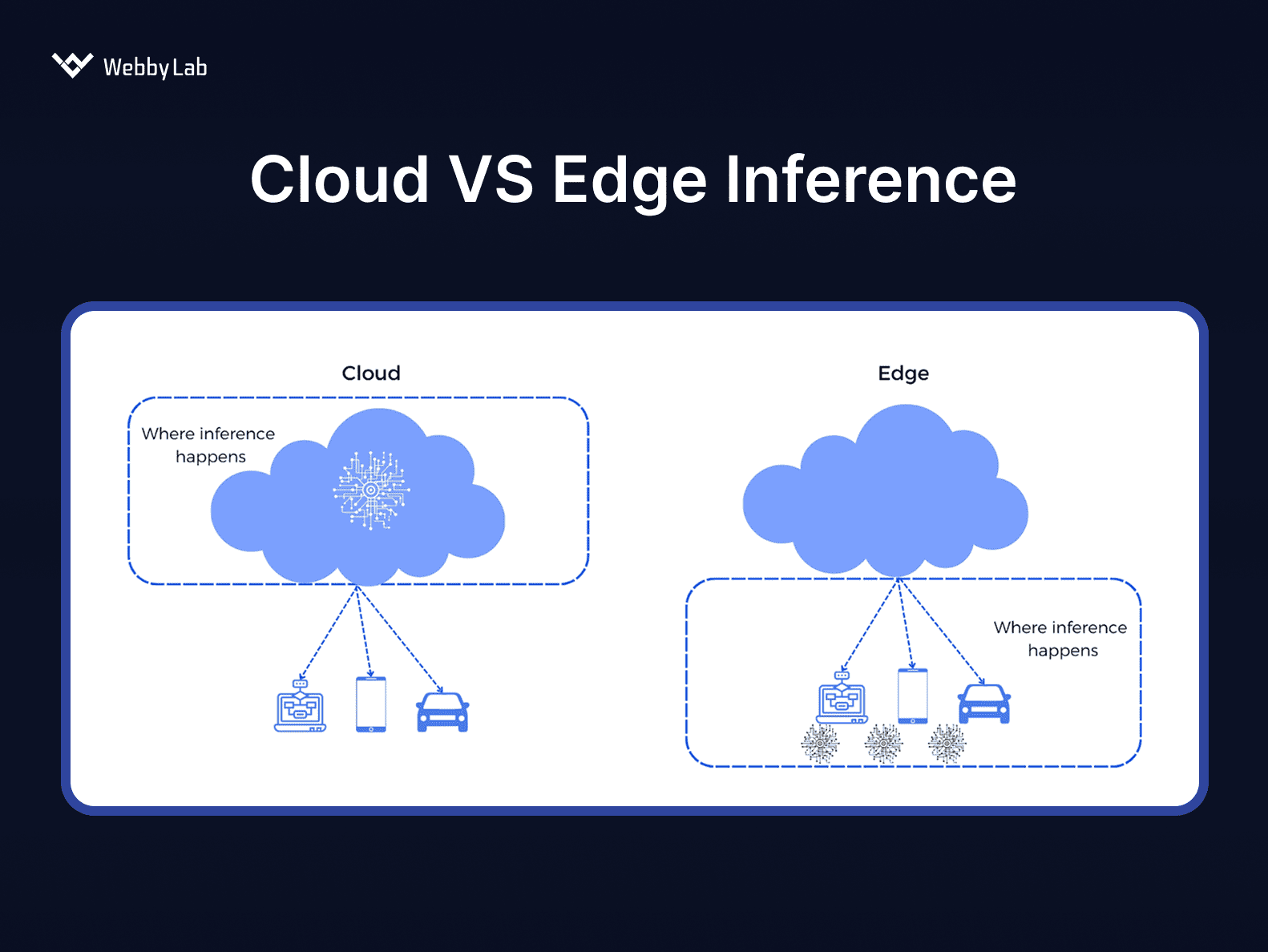
Cloud vs. edge inference
What Drives Enterprises to Choose Edge AI?
Enterprises don’t adopt new technologies for novelty. They adopt what makes operations faster, safer, and more cost-effective. Edge AI ticks all those boxes.
How Does Edge AI Reduce Latency?
Edge AI enables low-latency ML by processing data locally. This allows for real-time decision making, even in high-pressure scenarios, such as collision avoidance in autonomous vehicles.
How Does Edge AI Protect Data Privacy?
Edge AI privacy becomes possible since raw sensor data doesn’t need to leave the device at all. This includes any sensitive footage, biometric records, healthcare metrics, and beyond.
How Is Edge AI Resilient Offline?
Edge AI continues working even without (or with a weak) network connection. This offline ML inference is perfect for monitoring remote environments or mission-critical systems, such as agricultural facilities or pipelines in remote areas.
Why Is Edge AI Cost-Efficient?
Local inference for embedded ML models means fewer resources consumed in the cloud, less bandwidth usage, and lower long-term operational spend. You can scale devices without scaling cloud bills, particularly useful in retail and smart cities.
Looking to benefit from edge AI? Discover how WebbyLab helps achieve low-latency, private ML on embedded devices.
Explore moreWhat Are the Main Applications of ML on Edge Devices?
There are plenty of ML applications in edge AI, from predictive maintenance to energy optimization. Let’s go through the most prominent scenarios:
How Is Sound and Vibration Analysis Performed on Edge?
Sound and vibration data carry rich information on machine status, environmental conditions, and human interaction. Edge devices can analyze these raw signals in real time via ML models.
Use cases:
- Detecting wear or imbalance in machinery through vibration patterns.
- Wake-word recognition on devices for voice-activated control (“stop”, “go”).
- Industrial or safety event detection (leaks, impacts, alarms).
- Combining ML and microphone phased arrays for beamforming and sound source localization.
Tips for approaching this ML application:
- Low-cost MEMS microphones or accelerometers provide signals suitable for classification tasks.
- Models often rely on 1D CNNs, small RNNs, or MFCC-based pipelines.
- Data preprocessing includes resampling, normalization, and Mel spectrograms.
- Ambient noise conditions significantly affect robustness, and background noise augmentation is often required.
How Does Edge AI Support Predictive Maintenance?
Predictive maintenance powered by edge AI is one of the most common on-device ML applications. Running models locally enables continuous monitoring of machinery health and the detection of anomalies instantly.
Use cases:
- Early fault detection in rotating or vibrating machinery.
- Monitoring temperature, pressure, current, or vibration anomalies.
- Identifying system performance degradation or bottlenecks.
Tips for approaching this ML application:
- Reliability improves when multiple signals (vibration, temperature, and current) are combined.
- Classical ML (SVM, random forests) works well for low-dimensional data.
- Neural approaches (CNN, LSTM) are useful for temporal and spectral analysis.
- Deployment typically involves low-power microcontrollers (ESP32, STM32) or small Linux SBCs.
- Predictive maintenance via edge AI continues even without network connectivity.
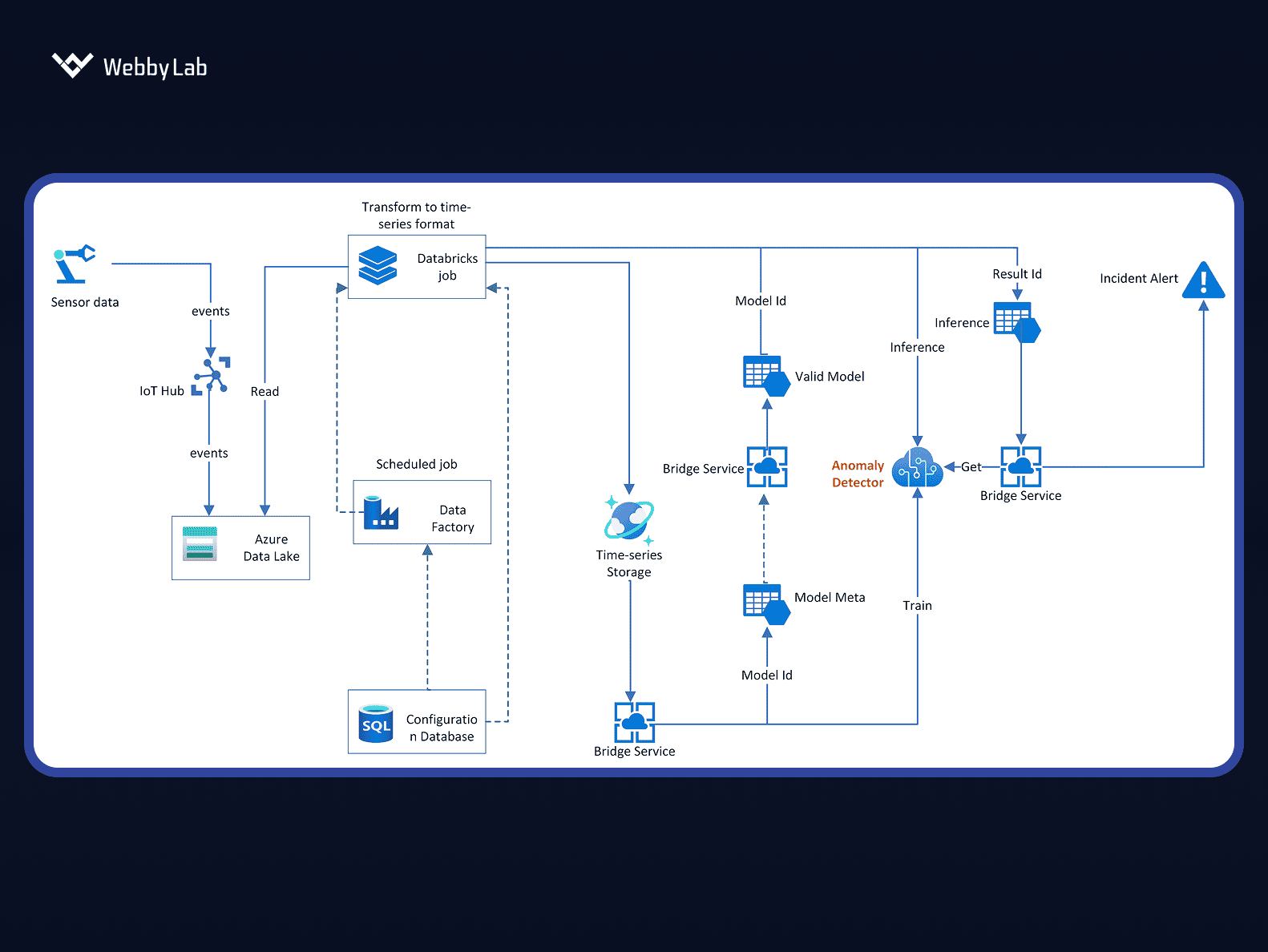
Microsoft Azure predictive maintenance solution with Multivariate Anomaly Detector
How Is Environment and Sensor Fusion Used in Edge AI?
Embedded systems often pull data from multiple environmental sensors and fuse them to guide optimization decisions.
Use cases:
- Smart agriculture edge AI, including irrigation control based on soil and microclimate data.
- Smart building lighting/HVAC automation via occupancy and environmental conditions.
- City infrastructure, covering noise/air quality mapping and adaptive traffic control.
Tips for approaching this ML application:
- Fusion of temperature, humidity, CO₂, light, and pressure enables richer, more accurate models.
- Regression or small feedforward networks predict optimal control signals locally.
- Synchronization across heterogeneous sensors remains a key challenge.
- Many applications benefit from incremental learning or adaptive thresholds.
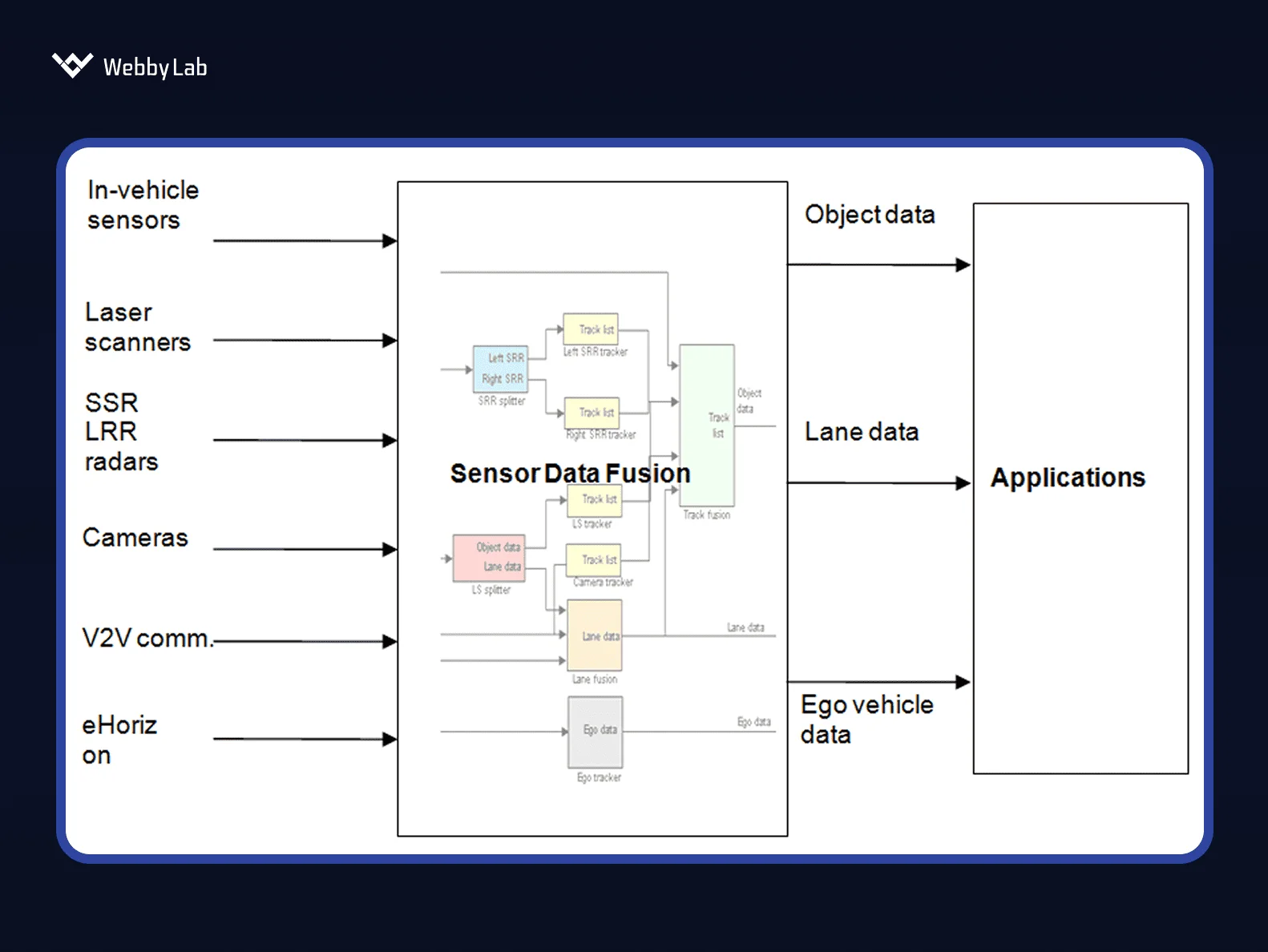
A sensor data fusion system: inputs and outputs
How Does Edge AI Handle Image and Video Processing?
Edge vision AI is one of the most powerful edge ML domains, enabling devices to interpret scenes, track motion, or even count people.
Use cases:
- Visual quality/defect detection in manufacturing.
- Gesture recognition for touchless human-machine interaction.
- Real-time video analytics (motion detection, people counting, occupancy).
Tips for approaching this ML application:
- Hardware-accelerated edge devices (Coral Edge TPU, Jetson Nano, RK3588) allow lightweight CNN inference.
- Quantized INT8 models reduce energy and memory consumption.
- Background subtraction, optical flow, and simplified object tracking still matter for lightweight pipelines.
- Gesture detection can run with low-resolution optical flow or pose estimation.
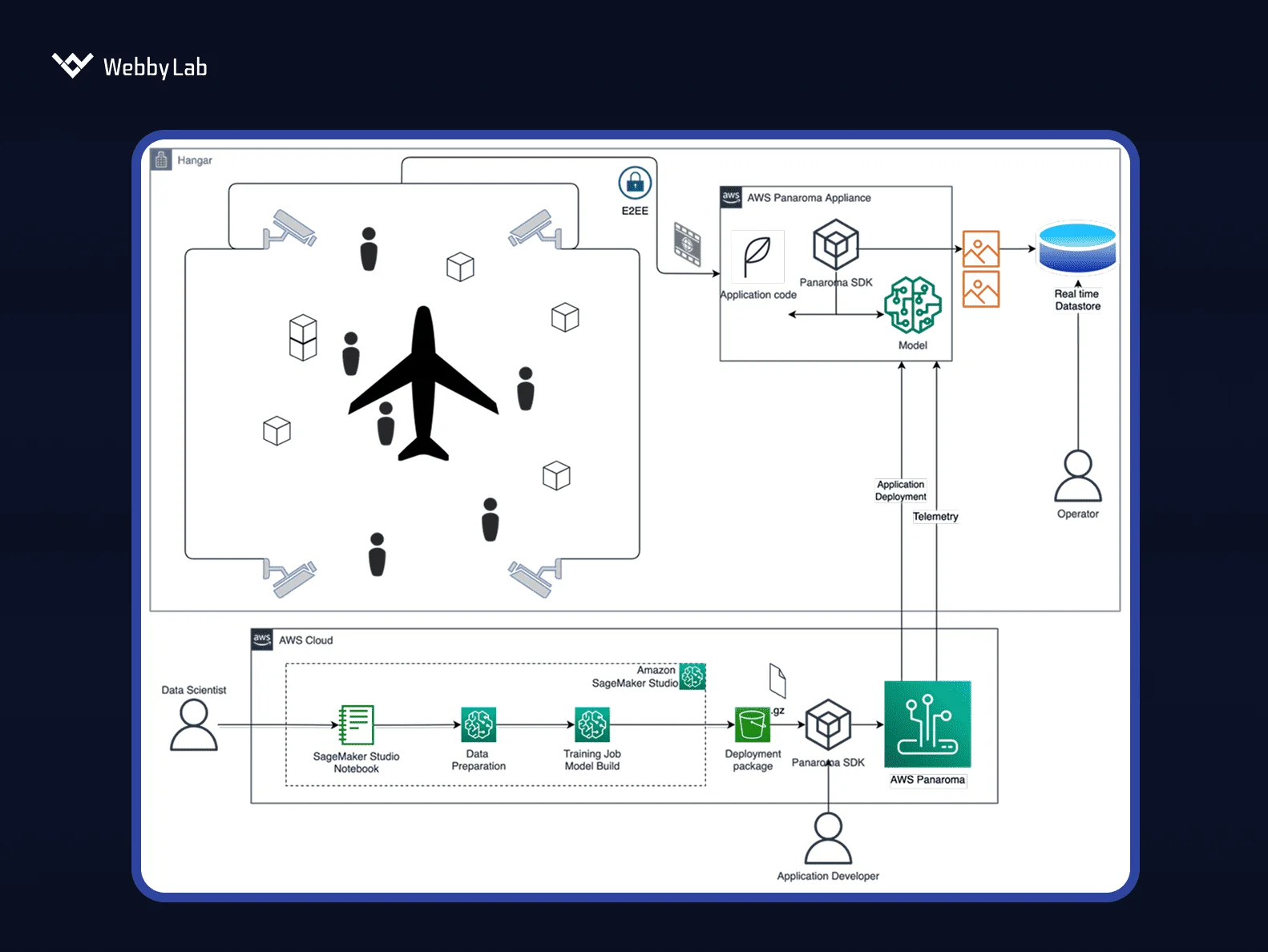
Computer vision via AWS Panorama reference architecture
How Is Edge AI Used for Energy Optimization?
Smart energy systems depend on local intelligence to balance consumption, storage, and distribution.
Use cases:
- Predictive HVAC and automated lighting.
- Power optimization in solar or battery-based systems.
- Edge power management for distributed sensor networks.
Tips for approaching this ML application:
- Regression models predict short-term consumption and adjust parameters dynamically.
- Local scheduling reduces cloud communication overhead.
- TensorFlow Lite Micro and similar frameworks allow trade-offs between accuracy and power draw.
Which ML Architectures Are Best for Edge Devices?
Your edge deployment’s success directly depends on the model architecture you choose. Here are the most commonly used approaches:
- 1D CNN edge models. Great for analyzing vibration, audio, and sensor streams.
- RNN or LSTM for temporal data. Useful for sequential or temporal data, where capturing patterns over time is required.
- Feedforward networks. Ideal for simple classification and control tasks.
- Regression on edge. Lightweight prediction for energy management and climate control.
- Multi-modal sensing ML pipelines. Combine audio, temperature, motion, or image data for more reliable decisions in, for example, enterprise-grade IoT solutions.
Who Is Using Edge AI in Production Today?
Edge AI has already found applications in products millions of people use daily and in industrial systems that run every minute. Here are some leading real-world examples:
- Apple — on-device ML at scale. Face detection, Photos intelligence, and privacy features run fully on-device using the Apple Neural Engine.
- Google — local ASR and NLP on Pixel/Gboard. Deploys on-device speech recognition and Assistant features that work offline with low latency.
- Siemens, Bosch, Honeywell — predictive maintenance at scale. These use edge AI ML for real-time industrial systems, handling such tasks as condition monitoring and asset health prediction.
- John Deere — See & Spray vision systems. Real-time computer vision distinguishes crops from weeds and controls spraying equipment on moving tractors.
- NVIDIA Jetson & Google Coral Edge TPU deployments — industrial edge AI. Jetson powers robotics, smart retail, and edge AI in manufacturing. Coral, meanwhile, accelerates inference on Raspberry Pi-class hardware for Edge TPU object detection and people counting.

Apple’s face detection workflow
Want to learn more? Read our post about how AI enhances IoT for smarter edge devices.
Ready to build or scale edge-powered AI solutions? Reach out for WebbyLab’s AI development services.
Learn moreConclusion
Edge AI is changing how companies process data. It enables lower latency, increased resilience, cost-effectiveness, and privacy-preserving ML on edge devices. Applications already span vibration analytics, predictive maintenance, energy optimization, computer vision, and sensor fusion. But there’s even more to come.


Written by:

Kostiantyn Oliynyk
Head of IoT at Webbylab
With a robust academic background in Telecommunication Systems Engineering, I apply my knowledge to lead innovations in the IoT domain. Starting as the first team member in the newly formed IoT department at WebbyLab, I've spearheaded its growth, fostering the expansion into embedded and hardware development alongside our core software projects. My dedication lies in pushing the boundaries of IoT technology, fostering a culture of innovation and excellence that profoundly impacts our clients' operational success.


FAQ
Can ML models run on low-power microcontrollers?
Yes. This field is known as TinyML, short for tiny machine learning. It involves using highly compressed ML models optimized for smaller, less powerful devices. Powered by lightweight architectures such as 1D CNNs, RNNs, or FNNs, these solutions can run efficiently on low-power microcontrollers, including ESP32 and STM32.
How does edge AI compare to cloud ML in latency and privacy?
Edge cloud orchestration debate lies in the fact that edge AI enables faster response times because inference happens locally and improves privacy since raw data stays on-device.
Which types of applications benefit most from edge AI?
Real-time, offline, or privacy-sensitive workloads, such as predictive maintenance, audio event detection, safety monitoring, energy optimization, and on-device vision, benefit most.
What open-source tools help deploy ML on edge devices?
On-device machine learning for IoT sensors can be deployed through TensorFlow Lite Micro, ESP-DL ML library, OpenCV, AI-on-the-edge-device, and ESP32 LLM.
How do enterprises manage updates and OTA deployments for edge models?
Most use centralized orchestration platforms with secure OTA updates, versioning, and staged rollout policies. These tools allow them to deploy, monitor, and fine-tune models across distributed fleets of devices without physical access.