
Optimizing IoT Project Management with RACI Matrix

The Internet of Things (IoT) projects go beyond software and hardware development. As with many other projects, they include communication, documentation, packaging, and more. This mix of processes needs proper management to deliver results. In this case, the RACI matrix is a strategic tool that brings order to chaos.
Defining who is Responsible, Accountable, Consulted, and Informed at every stage of an IoT project, the RACI framework clears up confusion around roles and ensures smooth collaboration. Learn more about this matrix and its application in our post.
WebbyLab will cover the RACI framework’s definition, alternatives, pros, and cons, using an IoT-based consumer electronics product as an example. We’ll explain how to distribute duties for effective IoT project management.
RACI Matrix Explained
The RACI matrix is a document that clarifies the roles and responsibilities of each stakeholder involved in the IoT project. Dividing team members into Responsible, Accountable, Consulted, and Informed, this framework lays out tasks to complete in a convenient chart. RACI is perfect for complex projects, especially those in the Internet of Things niche.
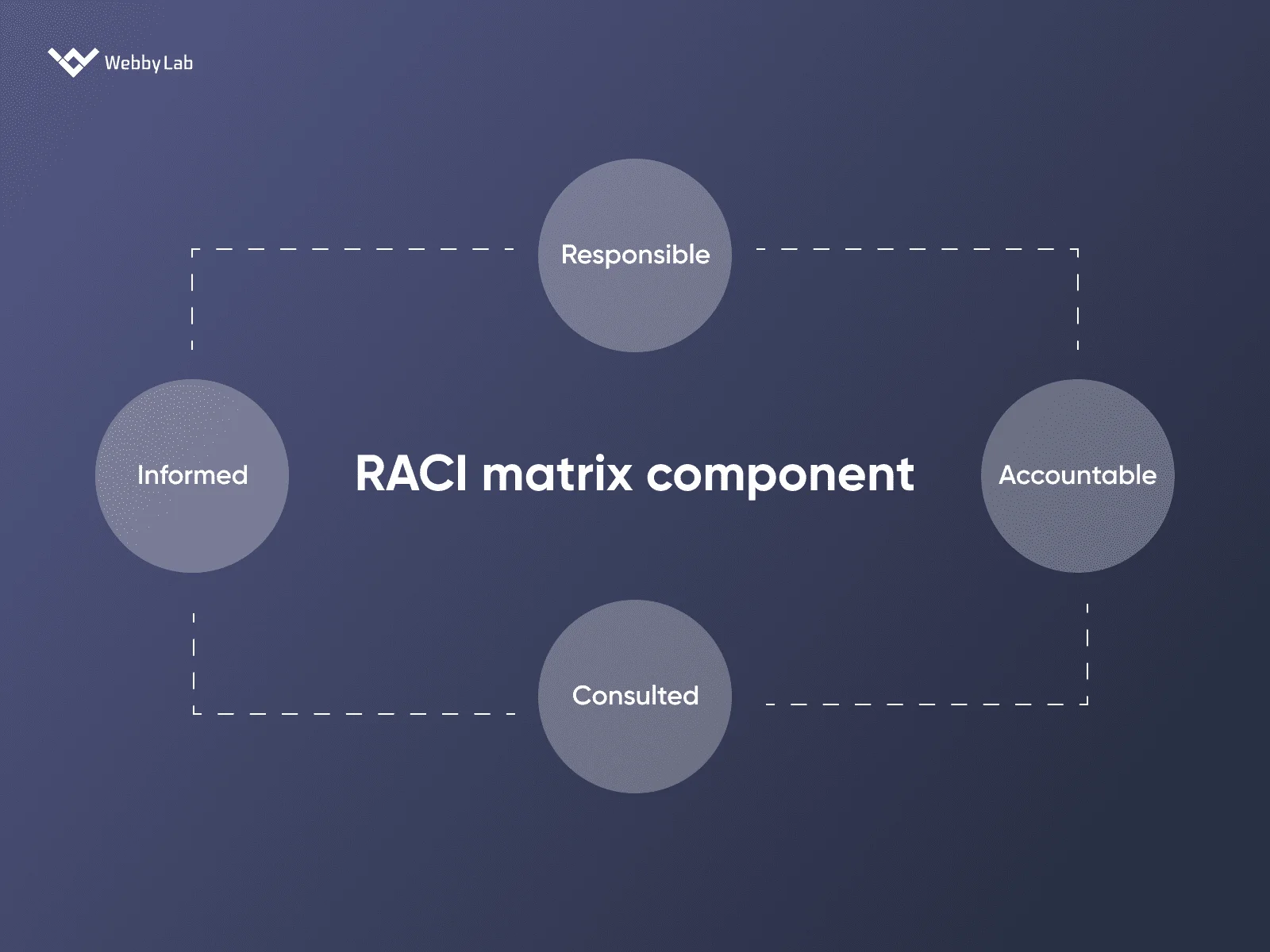
Let’s now study each RACI matrix component one by one:
- Responsible. This party is directly engaged in completing specific tasks within the IoT project. Simply put, they are the “doers” who create the deliverables. The responsible party typically comprises software developers, hardware engineers, designers, and other team members.
- Accountable. These stakeholders are the project’s ultimate decision-makers. They ensure the tasks are fully completed and follow the overall project objectives. The accountable party may include experts such as lead engineers, product owners, or business owners.
- Consulted. Consulted individuals provide expertise and feedback on the work within the IoT project. These stakeholders don’t execute the tasks directly but offer invaluable guidance and contribute to well-rounded decisions. This party usually comprises specialists in cybersecurity, regulatory compliance, or data privacy.
- Informed. This party consists of individuals who need to be kept informed about the tasks and outcomes but aren’t actively involved in task completion. Examples include business owners and external stakeholders who require a broader project perspective.
Alternatives and Subtypes of RACI in IoT
RACI is a universal responsibility distribution matrix for IoT and other IT or software development projects. Based on this adaptable framework, several alternatives have emerged. They address specific project features and are as follows:
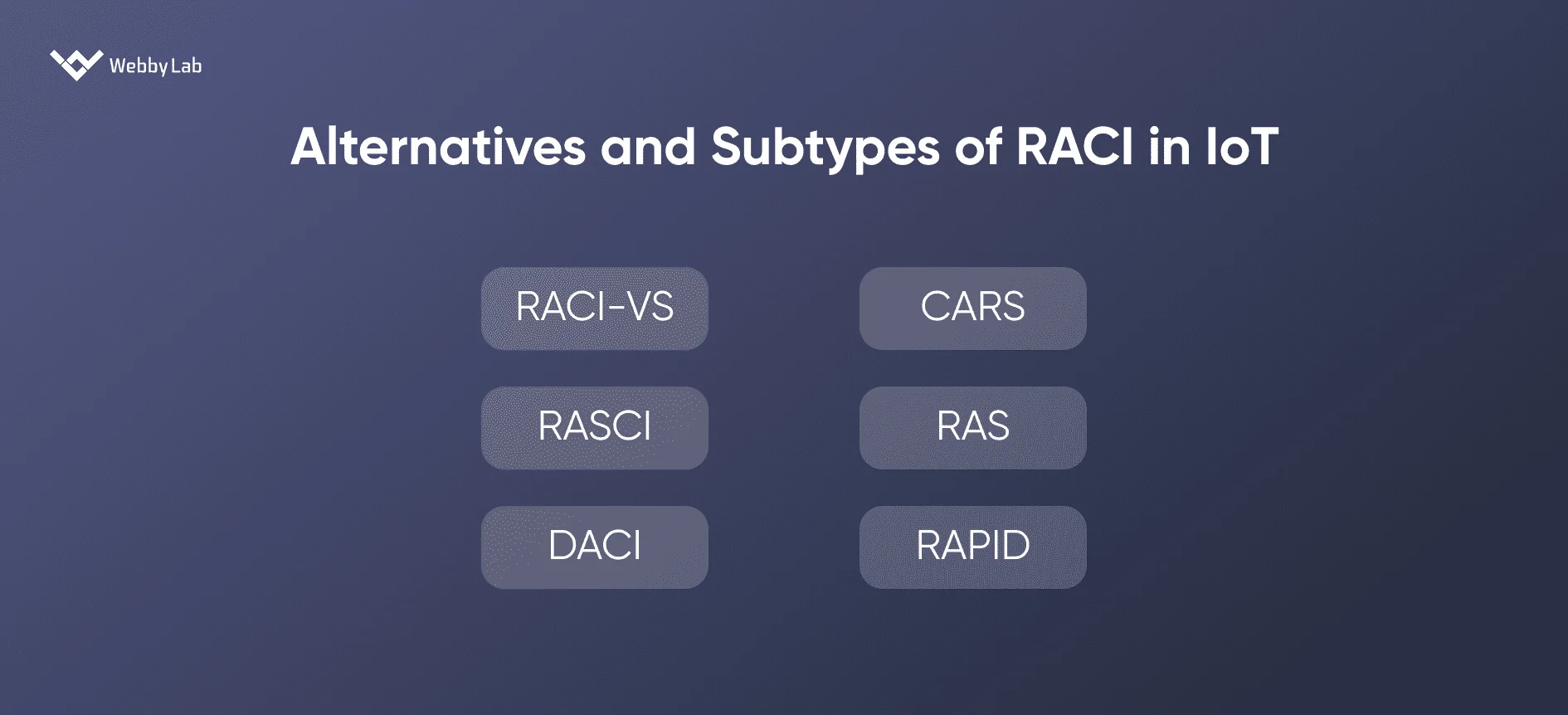
RACI-VS
RACI-VS introduces two additional components to the standard RACI matrix — Verifier and Signatory. The Verifier ensures that the IoT project meets the predetermined criteria and objectives. The Signatory, in turn, validates the Verifier’s decision and has a final take on project deliverables.
RASCI
RASCI adds a Supportive role to the traditional RACI framework. These individuals provide assistance and resources to the Responsible party and help complete the tasks. Notably, the Supportive employees don’t bear responsibility for the project outcomes.
DACI
DACI introduces four roles — Driver, Approver, Contributor, and Informed. The Driver oversees the entire project and the decision-making process. Contributors perform the tasks, the Approver verifies decisions, and the Informed role mirrors the RACI matrix.
CARS
CARS divides the IoT project into the following roles: Communicate, Approve, Responsible, and Support. It shifts the focus to effective communication and consolidates RACI’s Consulted and Informed into a single Communicate position. The Approve handles decision-making, the Responsible completes the tasks, and the Support assists the Responsible in task execution.
RAS
RAS simplifies the CARS matrix by combining Responsible, Approve, and Support into a concise structure. In this scenario, communication occurs within the team.
RAPID
RAPID comprises five key roles — Recommend, Agree, Perform, Input, and Decide — to highlight the diverse aspects of decision-making and distinguish authoritative from accountable positions. According to this framework, the project starts with a suggested action by the Recommend party and moves forward following the Decide role’s instructions.
Pros and Cons of the RACI Matrix
As with any project management tool, the RACI matrix has distinct advantages and challenges. Let’s get those straight.
RACI Matrix Pros
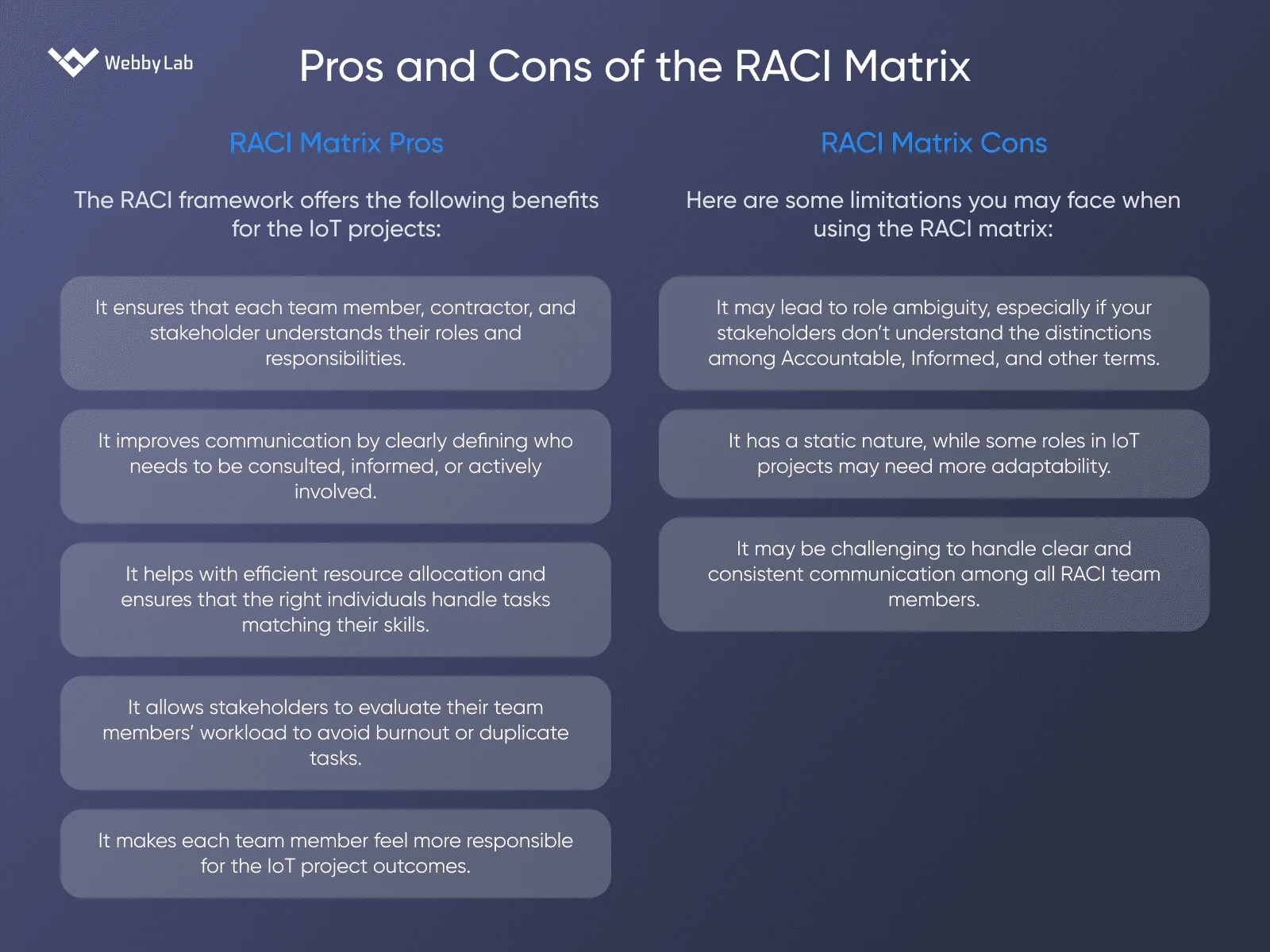
The RACI framework offers the following benefits for the IoT projects:
- It ensures that each team member, contractor, and stakeholder understands their roles and responsibilities.
- It improves communication by clearly defining who needs to be consulted, informed, or actively involved.
- It helps with efficient resource allocation and ensures that the right individuals handle tasks matching their skills.
- It allows stakeholders to evaluate their team members’ workload to avoid burnout or duplicate tasks.
- It makes each team member feel more responsible for the IoT project outcomes.
RACI Matrix Cons
Here are some limitations you may face when using the RACI matrix:
- It may lead to role ambiguity, especially if your stakeholders don’t understand the distinctions among Accountable, Informed, and other terms.
- It has a static nature, while some roles in IoT projects may need more adaptability.
- It may be challenging to handle clear and consistent communication among all RACI team members.
Let’s explore how the RACI matrix can streamline your IoT project management
Get a consultationHow to Create a RACI Matrix
Building an efficient RACI matrix takes several steps. They are as follows:
- Define your project scope and objectives. You should clearly understand the key deliverables and milestones for proper RACI matrix creation.
- Identify stakeholders and assign RACI roles to them. Determine which team members, external consultants, clients, and other parties are involved in your IoT project and outline their roles.
- List project tasks. Break down the project into specific tasks and activities, ensuring you cover all aspects of IoT development service, from hardware design to software development.
- Assign RACI roles to each task. Distribute the tasks among the Responsible, Accountable, Consulted, and Informed.
- Communicate the matrix. Gather your team members and stakeholders to explain their roles and responsibilities outlined in the matrix.
What to Avoid When Creating a RACI Matrix
You surely want to manage your IoT project effectively. To achieve smooth management, consider the following things to avoid when building a RACI matrix:
- Ambiguous responsibilities. Determine roles in your IoT project as clearly as possible to avoid confusion among team members.
- Static responsibilities. Review and update the matrix regularly as your project grows.
- Lack of communication. Explain the matrix to your team to improve collaboration and overall understanding of the roles.
- Lack of task prioritization. Make sure you emphasize the most important project tasks and assign the most experienced team members to them.
- Too many Consulted parties. Having a lot of Cs can slow down your project significantly. Consider reducing their number or changing their role to Informed.
- Lack of task accountability. Ensure you include one Accountable party for each project task.
WebbyLab’s Experience in Using the RACI Matrix
WebbyLab uses the RACI matrix to divide the areas of responsibility and IoT project phases, particularly when coordinating multiple contractor teams. An illustrative case is the launch of our proprietary consumer electronics product — a smart table lamp.
To launch such an IoT product, you need to have:
- Manufactured device (device body, smart controller, and other components)
- Firmware
- Software (mobile app, cloud app, and others)
- Packaging
- Device manual
- Power supply unit
With the above elements combined, you get a finished product ready for sale in the marketplace or on store shelves.
The challenge in such projects arises if there are limited turnkey contractors in the market, and the available options might be scarce, compromise on quality, or come at a higher cost. While there are trusted vendors, they usually cover different aspects of an IoT project.
To bring the project to a logical point — when the product reaches its user — it’s necessary to manage the processes among various contractors and team members effectively. That’s when the RACI matrix comes in handy.
Here’s a simple RACI matrix example we’ve created:
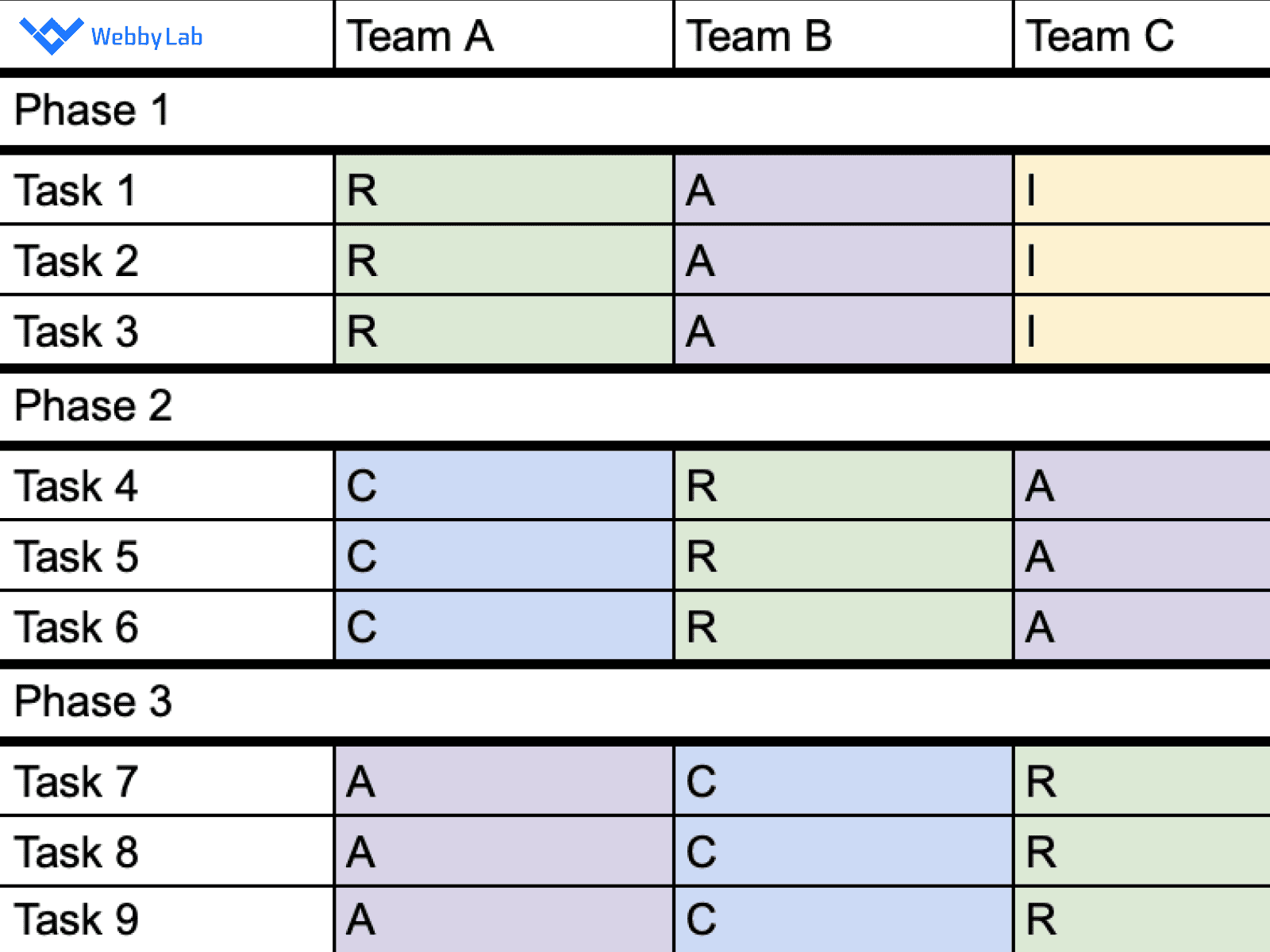
A generic example of the RACI matrix chart.
Then, we tailored the chart to our project — a smart lamp. We divided the tasks among multiple contractors and team members and broke down the processes into several stages: product, hardware, firmware development, software development, and beyond.
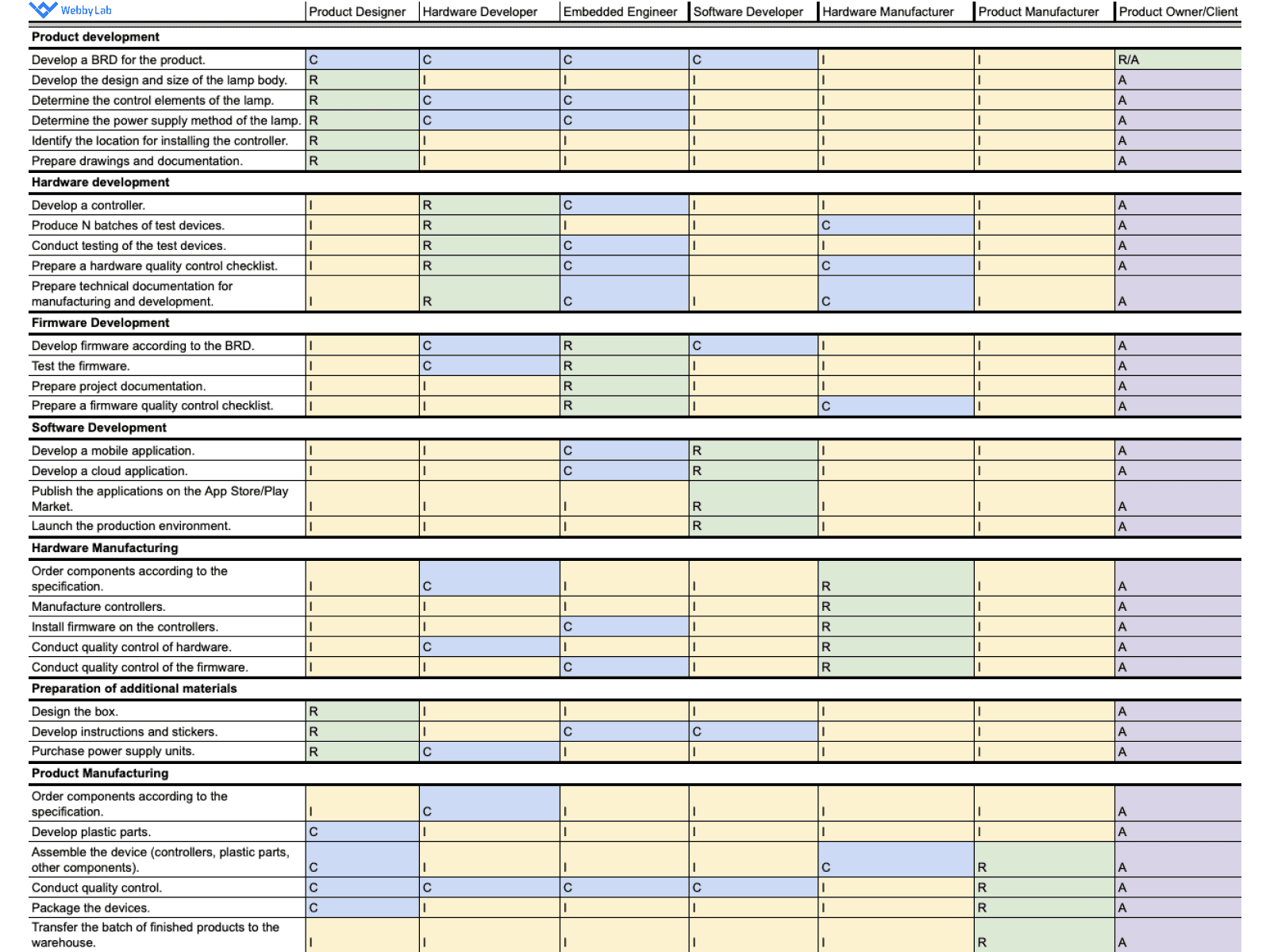
An example of the RACI matrix for a smart IoT-based lamp creation.
As you can see from the chart, our client (or the product owner) holds the Accountable role in the project. That’s because they oversee the entire project and accept work as the most invested party at each stage.
When creating such a matrix, we considered that contractors can block each other. For example, firmware development may require a controller, and the controller relies on a peripheral that it controls. Mobile application developers, in turn, depend on the firmware.
Since all processes are interconnected, we usually work following the Gantt chart, which resembles a structured project schedule. It ensures that we synchronize teams at optimal times to mitigate blockers. We also incorporate the inputs section in the RACI matrix, where each team provides information on their performed work. This practice guarantees a task handover process and mitigates potential bottlenecks.
Final Thoughts
Any IT project, especially in the Internet of Things industry, requires proper management. The RACI matrix is a perfect tool for that. It ensures clear role and responsibility distribution, promotes effective communication, and helps avoid task over-complication.
If you want to leverage the RACI framework for your project, consider consulting with a WebbyLab team. Having implemented this matrix in our previous works, we can advise you on how to apply it and achieve the best possible outcomes.


Written by:

Kostiantyn Oliynyk
Head of IoT at Webbylab
With a robust academic background in Telecommunication Systems Engineering, I apply my knowledge to lead innovations in the IoT domain. Starting as the first team member in the newly formed IoT department at WebbyLab, I've spearheaded its growth, fostering the expansion into embedded and hardware development alongside our core software projects. My dedication lies in pushing the boundaries of IoT technology, fostering a culture of innovation and excellence that profoundly impacts our clients' operational success.

