Key Results:
- 80% reduction in defect rate
- Calibration time reduced from 20 minutes to 5 minutes
- Quality check time reduced by 85% (from 10 min/hour to alarm-based only)
- Prevention of $100-200 material waste and 3-5 days production time loss per incident
PROBLEM STATEMENT
Industry Challenge
Manufacturers of extruded materials (3D printing filament, profiles, cables) face critical quality control challenges:
Quality Issues:
- Diameter variations (too small or too large)
- Physical defects (bubbles, cracks, irregularities, inclusions)
- Contamination (“dirt”) in composite materials
- Inconsistent material properties across production batches
Operational Inefficiencies:
- Manual calibration required every material loading (20 minutes per setup)
- Systematic quality checks consuming 10 minutes per hour throughout shifts
- High false negative rate leading to customer returns
- Expensive material waste ($100-200 per defective batch)
- Production downtime (3-5 days) due to customer complaints
Cost of Quality Failures:
- Direct material costs
- Customer dissatisfaction and returns
- Production line adjustments
- Manual inspection labor
- Reputation damage
Limitations of Existing Solutions
LIDAR Systems:
- Precise measurements but inflexible
- No software ecosystem for analytics
- Cannot detect surface defects or contamination
- No customization options
- Limited integration capabilities
Laser Measurement Systems:
- One-dimensional measurement only
- Cannot identify defect types
- No real-time feedback loop
- Expensive maintenance
- Limited to diameter control
Manual Inspection:
- Time-consuming
- Inconsistent results
- Human error prone
- Cannot inspect 100% of material
- No automated documentation
SOLUTION OVERVIEW
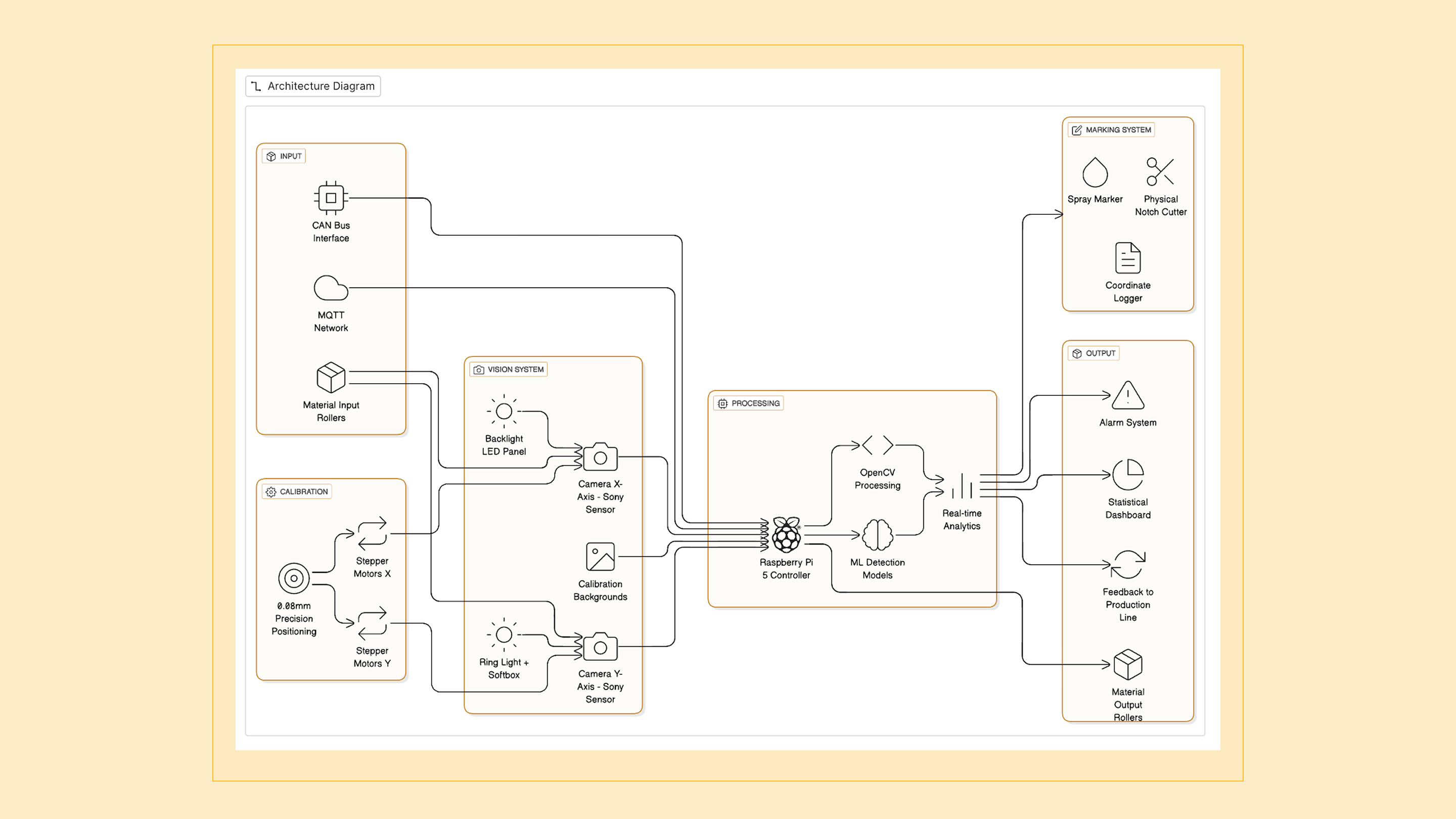
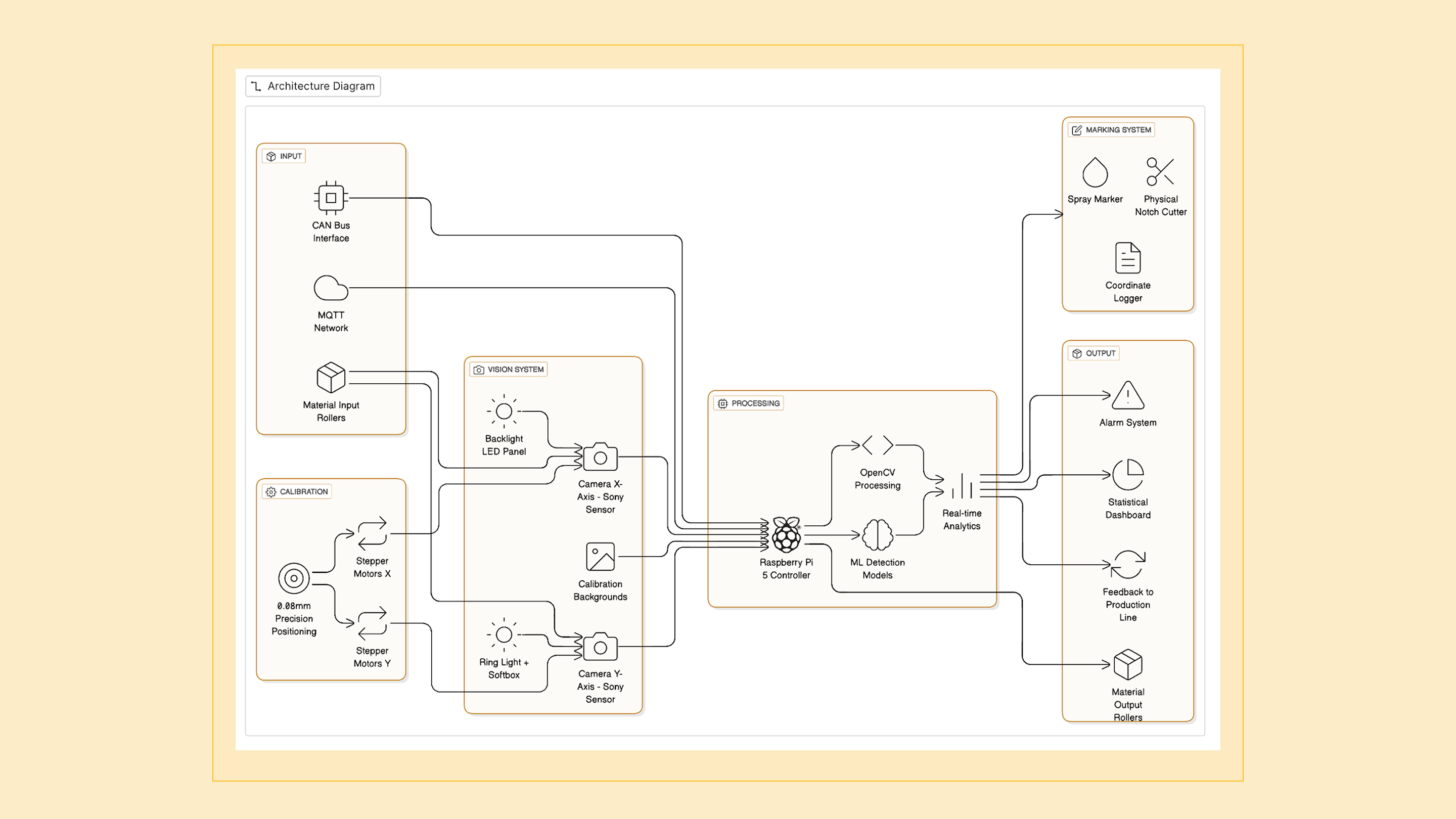
System Architecture

Key Features
Dual-Camera Configuration:
- X-axis camera for horizontal diameter measurement
- Y-axis camera for vertical diameter measurement
- Sony sensors with custom macro extension lenses
- Full HD resolution at 60 FPS
- Adjustable focal distance
Lighting Modes:
- Backlight: LED panel for contour measurement
- General: Ring light with softbox for surface inspection
- White spectrum with calibration backgrounds
- Switchable modes for different defect types
Defect Detection:
- Diameter variations (under/oversized)
- Surface irregularities
- Bubbles and voids
- Cracks and fractures
- Contamination particles
- Composite material inclusions
- Configurable detection threshold (10-50+ microns)
Marking System:
- Physical notch cutting for permanent marks
- Spray marker for temporary identification
- Coordinate logging for digital tracking
- Selectable marking mode based on severity
Precision Positioning:
- Stepper motor-driven camera adjustment
- 0.08mm positioning accuracy
- Automated distance calibration
- Two-axis movement (X and Y)
TECHNICAL IMPLEMENTATION
Hardware Architecture
Power Supply:
- 5V rail for Raspberry Pi and logic circuits
- 12V rail for lighting, motors, and actuators
- Regulated power distribution
Motion Control:
- Stepper motor drivers
- Precision linear actuators
- Position feedback encoders
- 0.08mm repeatability
Compute Platform:
- Raspberry Pi 5 controller
- Dedicated vision processing
- Real-time OS capabilities
Vision Hardware:
- 2x Sony Global Shutter sensors
- Custom macro lens assemblies
- Adjustable focal length system
- High-speed image capture (60 FPS @ 1080p)
Communication:
- CAN Bus for industrial integration
- MQTT for IoT connectivity
- Web interface for monitoring
- RESTful API for external systems
Material Handling:
- Input rollers with tension control
- Output rollers with speed synchronization
- Maximum processing speed: 50 cm/second
- Higher speeds may cause frame skipping
Software Architecture
Processing Pipeline:
- Image Acquisition (60 FPS per camera)
- Preprocessing (contrast enhancement, noise reduction)
- Processing mode selection:
- Normal mode: Standard RGB processing
- High-contrast monochrome: Binary threshold for precise edges
- Edge enhancement: Highlight sharp object boundaries
- Object detection and measurement
- Defect classification
- Decision-making and action triggering
Key Algorithms:
Diameter Measurement:
- Dual-axis measurement for circularity
- Multi-point sampling (5-15 measurements per frame)
- Statistical analysis (mean, min, max, standard deviation)
- Tolerance-based quality grading
Defect Detection:
- Adaptive thresholding for varying lighting
- Morphological operations for noise removal
- Contour analysis with area filtering
- Edge detection (Canny algorithm)
- Connected component analysis
- ML-based classification (in development)
Calibration System:
- Automated pixel-to-millimeter mapping
- Reference object learning
- Grid overlay for visual confirmation
- Stepper motor auto-positioning
- Background calibration reference
Processing Modes
Normal Mode:
- Full RGB processing
- General purpose inspection
- Surface feature detection
High-Contrast Monochrome:
- CLAHE (Contrast Limited Adaptive Histogram Equalization)
- Otsu’s thresholding
- Maximum edge definition
- Optimal for diameter measurement
Edge Enhancement:
- Gaussian blur preprocessing
- Canny edge detection
- Red overlay of detected edges
- Optimal for surface defect identification
OPERATIONAL WORKFLOW
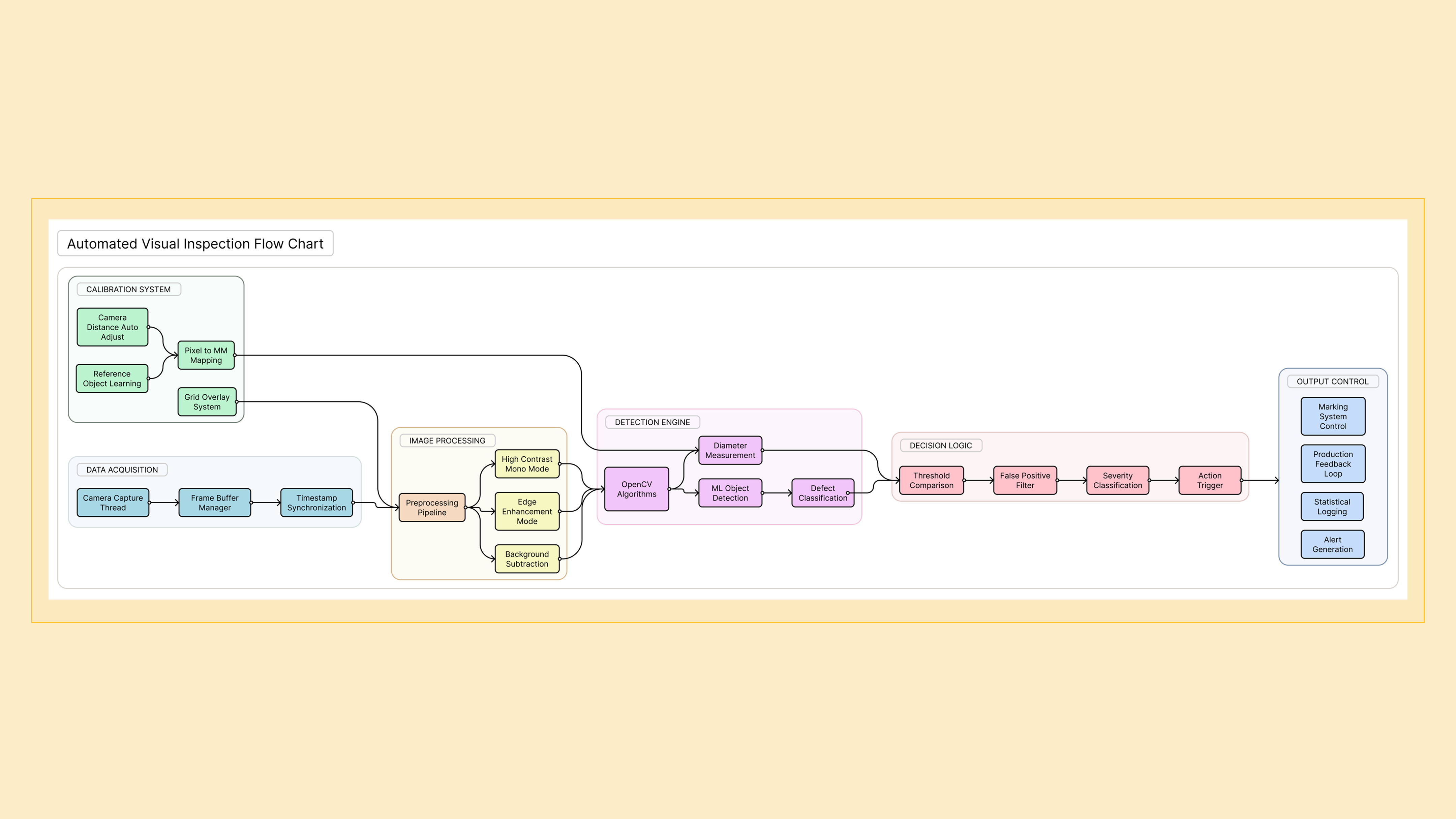
System Workflow
Options
Standalone Mode:
|
MQTT Network Integration:
|
CAN Bus Integration:
|
Feedback Loop Configurations:
|
RESULTS AND IMPACT
1. Quantitative Results
Quality Improvement:
- Defect rate reduction: 80%
- False positive rate: ~10% (acceptable threshold)
- Material waste prevention: $100-200 per incident
- Production downtime prevention: 3-5 days per incident
Operational Efficiency:
- Initial calibration: 20 minutes → 5 minutes (75% reduction)
- Quality checks: 10 min/hour continuous → alarm-based only (85% reduction)
- Total inspection time saved: ~40 minutes per 8-hour shift
Process Improvements:
- 100% material inspection vs. sampling-based manual checks
- Real-time defect detection vs. post-production discovery
- Automated documentation and traceability
- Consistent measurement accuracy (no human variability)
2. Return on Investment
Cost Analysis:
Development Investment: $40,000 – $60,000 Hardware Cost per Unit: ~$5,000 Total Initial Cost: $45,000 – $65,000
Savings per Incident Prevented:
- Material cost: $100-200
- Production downtime: 3-5 days (estimated $2,000-5,000)
- Customer relationship preservation: immeasurable
- Total per incident: $2,100-$5,200
Break-even Analysis: If system prevents 10-15 critical defects per year: ROI achieved within 12-18 months
Ongoing Benefits:
- Labor cost reduction (inspection time)
- Increased customer satisfaction
- Premium pricing for guaranteed quality
- Reduced warranty claims
CONCLUSIONS
Key Achievements
This AI-powered vision system successfully addresses critical quality control challenges in extrusion manufacturing through:
Technical Innovation:
- Dual-axis measurement for complete dimensional analysis
- Multi-mode lighting for diverse defect detection
- Real-time processing at production speeds
- Flexible integration via CAN Bus and MQTT
Operational Impact:
- 80% defect reduction in precision products
- 75% reduction in calibration time
- 85% reduction in quality inspection time
- Prevention of costly material waste and production delays
Economic Value:
- ROI achievable within 12-18 months
- Significant cost advantage over LIDAR alternatives
- Comprehensive solution vs. limited laser measurement systems
- Automation of labor-intensive manual inspection
APPENDICES
System Architecture Diagram