
Understanding IoT Connectivity: Technologies, Network Types, and Key Challenges
Choosing the right IoT connectivity technologies isn’t easy. Learn how to make a good choice with WebbyLab’s guide to key types and decision-making factors.

Without IoT connectivity technologies, IoT devices simply can’t fulfill their purpose, but choosing the right one is easier said than done. Each choice has its own pros and tradeoffs in price, scalability, and reliability.
At WebbyLab, we routinely consider a myriad of factors to select the right technologies for specific IoT use cases, from industrial heat pumps to EV charging stations.
Keep reading our IoT connectivity comparison guide to discover your options and what to consider before picking one.

SmartHeat application developed by WebblyLab
Highlights
- IoT connectivity refers to the technologies that enable IoT devices to exchange data.
- Cellular, short-range, LPWAN, satellite, and wired are the main types of IoT connectivity.
- To choose the right IoT connectivity technology, consider coverage and range, latency and data transfer, energy efficiency, scalability and costs, and security and reliability.
Defining IoT Connectivity
IoT connectivity is a broad term that encompasses all the technologies used by IoT devices to exchange data with other sensors, applications, and cloud platforms.
Here’s how IoT devices communicate:
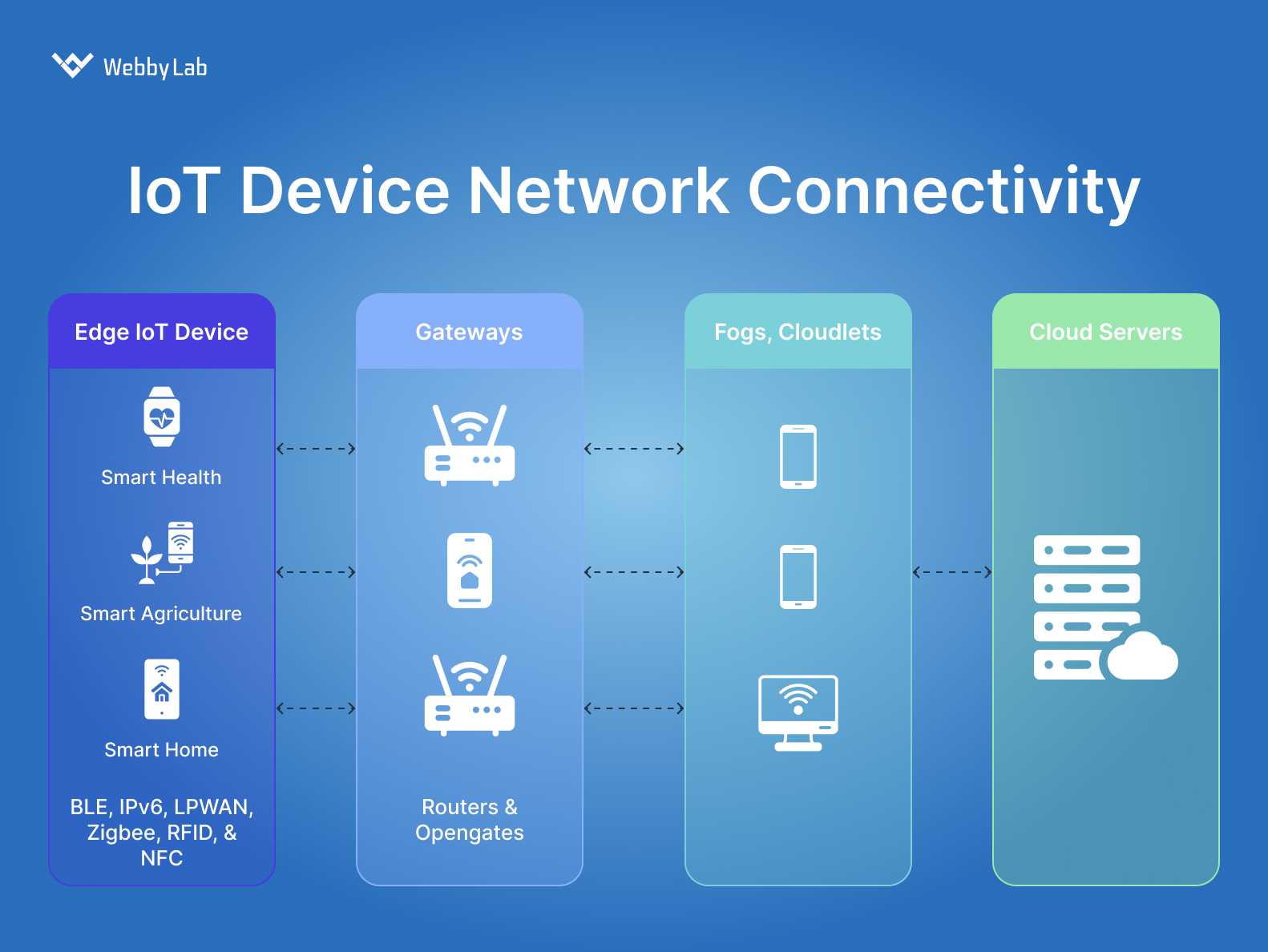
How IoT connectivity technologies work
Every IoT network encompasses multiple types of devices and applications. Each of them has its own range, energy consumption, security, and network limitations and requirements.
IoT communication protocols are the standards that define how data is packaged and transmitted. They ensure all parties participating in the exchange speak the same language.

5 Types of IoT Connectivity to Know
IoT connectivity technologies can be largely grouped into five categories.
Cellular IoT Networks
Technologies: 2G/3G/4G/5G, NB-IoT, LTE-M, LTE Cat-1 / Cat-1 bis
Cellular networks use technologies such as 5G and LTE-M and are best suited for large-scale IoT deployments or solutions that require wide coverage.
Short-Range IoT Networks
Technologies: Wi-Fi, Bluetooth (BLE, BLE Mesh), Zigbee, NFC, RFID
Short-range networks connect devices within the immediate vicinity, such as smart home sensors and wearables.
LPWAN IoT Networks
Technologies: LoRaWAN, Sigfox
Low-power wide-area networks (LPWAN) combine low power consumption with wide IoT network coverage and range for setups in industrial settings.
Satellite IoT Networks
Technologies: NB-IoT/NR, LoRaWAN-by-satellite
Satellite IoT connectivity is usually the optimal choice for remote or maritime systems where other types of connectivity (e.g., cellular) are unfeasible.
Wired IoT Networks
Technologies: Ethernet
Since wired connectivity relies heavily on physical infrastructure (e.g., Ethernet cables), it’s suitable for stable industrial IoT enterprise solutions.
How They Compare
Each IoT network represents a tradeoff between three criteria:
| Type | Range | Bandwidth | Power consumption |
| Cellular | High | High | High |
| Satellite | High | High | High |
| Wi-Fi | Low | High | Low |
| Bluetooth | Low | High | Low |
| Ethernet | Low | High | Low |
| Low-power wide-area networks (LPWAN) | High | Low | Low |
Struggling to pinpoint the right IoT connectivity strategy? Let’s define one together. Book a free consultation with WebbyLab experts.
Book a consultationChoosing the Right IoT Connectivity: Factors to Consider
Each case is unique, so there’s no cookie-cutter algorithm for how to choose the right IoT connectivity technology.
That said, when we provide IoT device consulting services, we consider these five key factors first.
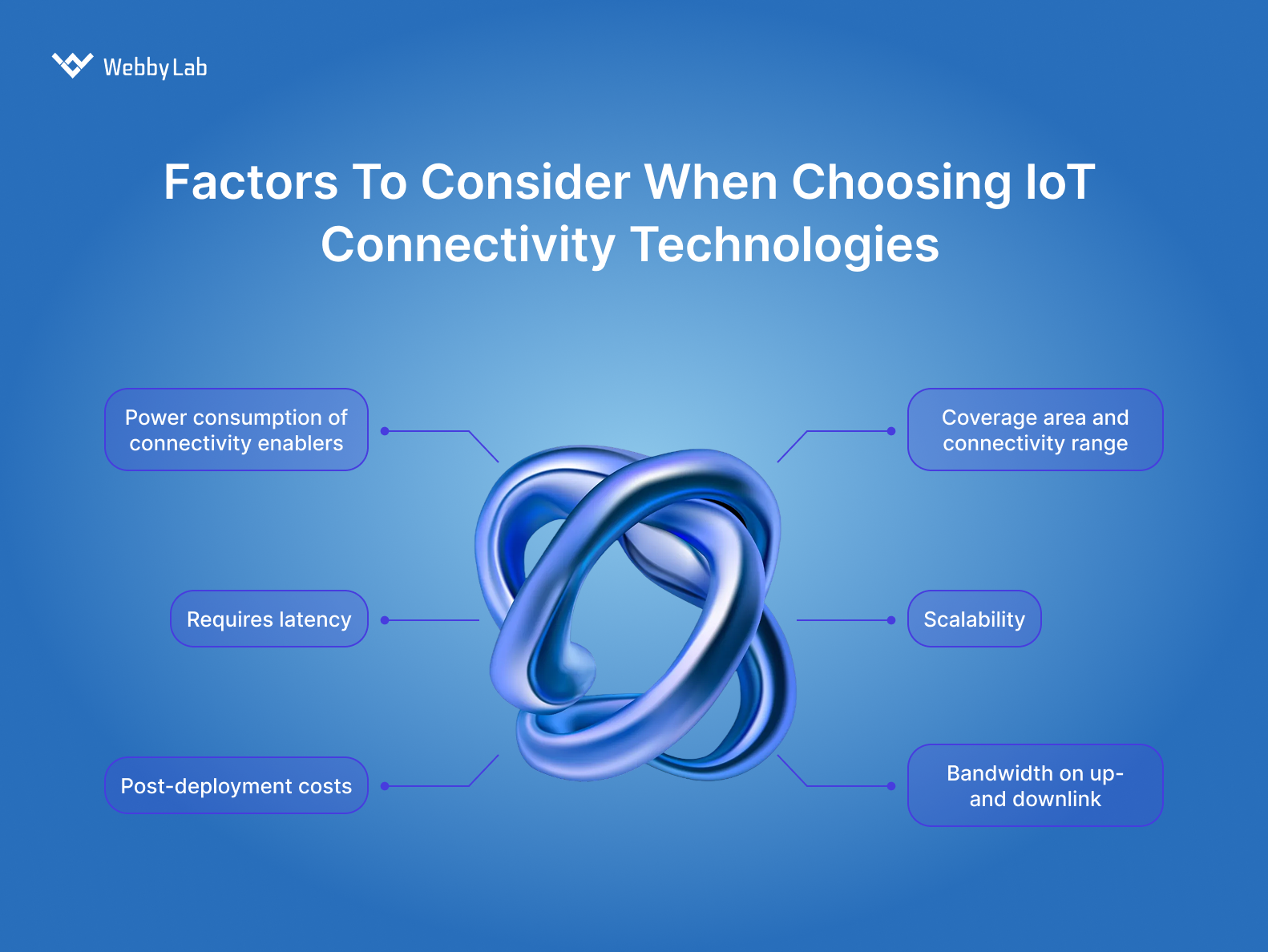
Key factors to consider
Important: You may need more than one technology. For example, the solution we developed for Propuskator had to be compatible with different controller variants. Or, when working on Mybox, we chose Wi-Fi and Ethernet for cloud services and Bluetooth for authorization.
Coverage and Range
First, take into account the distance between the nodes participating in the data exchange (IoT devices, smartphones, gateways, etc.). This distance can be broken down into several categories, each with its own IoT connectivity solutions:
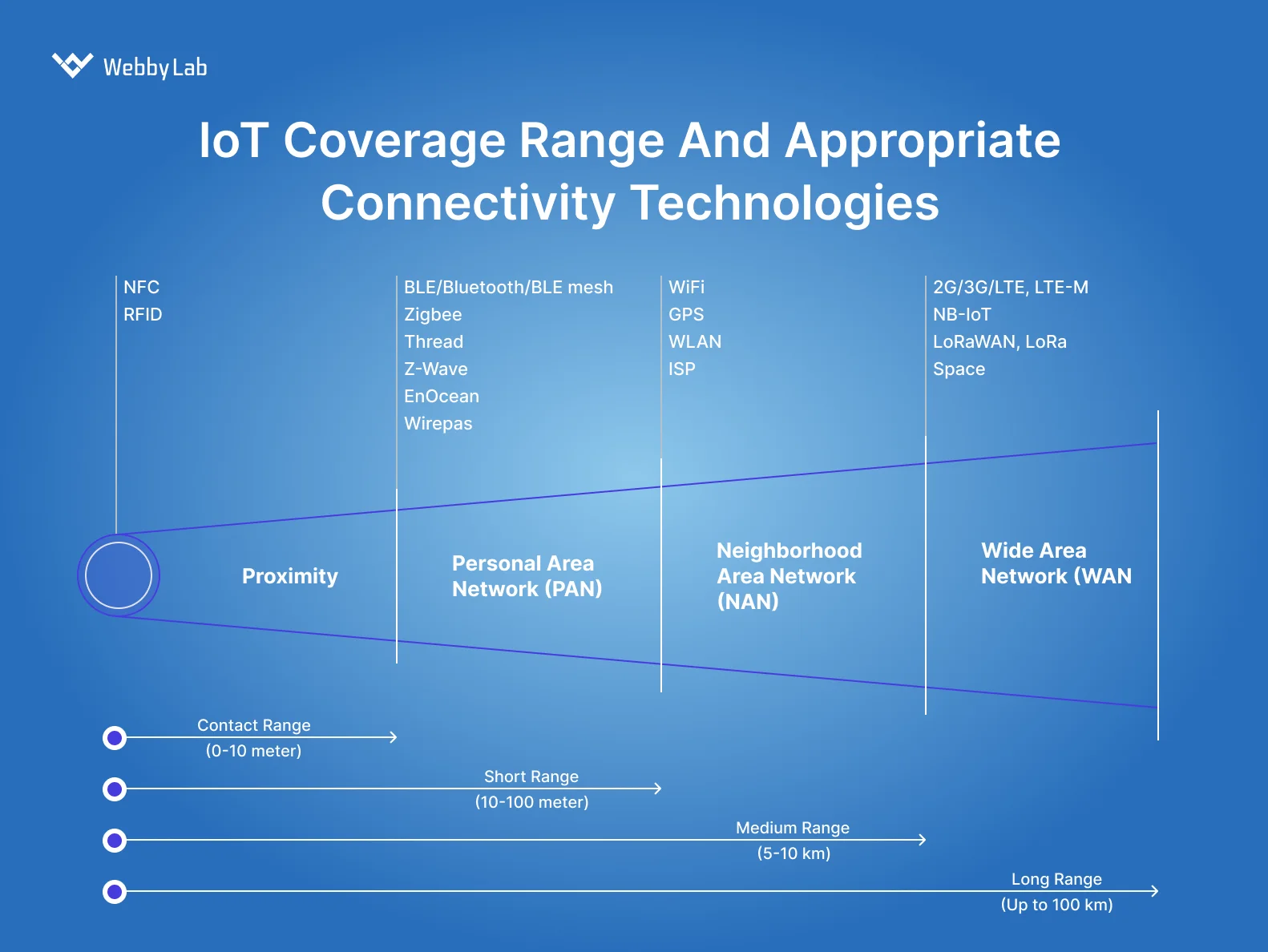
IoT connectivity technologies based on coverage range
| Range | Distance | Examples | Technologies |
| Short | < ~30-50 meters (indoors)
< 100 meters (line-of-sight) |
Room, building | Bluetooth/BLE, BLE mesh*, Zigbee*, Z-Wave*, Thread (Matter)*
* – could be scaled to Medium |
| Medium | ~50-500 meters
< 1 km (line-of-sight) |
Warehouse, factory | Wi-Fi, Ethernet, industrial TSCH, private LTE/5G |
| Long | < tens of kilometers | City, region | LoRaWAN, Wi-SUN FAN, cellular IoT |
| Super-long | Worldwide, remote | Global remote systems, systems in oceans or deserts | Satellite IoT |
Latency and Data Transfer
How often will the IoT device send data, and how big will the payload be? Both IoT data transfer and latency can affect your choice. For example, video surveillance typically requires high-bandwidth technologies with minimum latency.
Let’s start with data volumes and transfer frequency:
| Category | Suitable technologies |
| Rare byte-sized payloads | LoRaWAN, Wi-SUN FAN, Bluetooth/BLE |
| Small but frequent data transfers (tens to hundreds of bytes) | BLE Mesh, Zigbee, Z-Wave, Thread (Matter), industrial TSCH networks |
| Mid-sized data volumes, regular data bursts (measured in Kb or MB) | Wi-Fi, private LTE/5G, cellular IoT (LTE-M, Cat-1) |
| High-bitrate, continuous real-time data streams | Ethernet, Wi-Fi, private LTE/5G, cellular IoT (4G/5G) |
| Remote locations with expensive transfer costs | Satellite IoT |
And here’s how different technologies fare in latency:
| Latency | Technologies |
| Very low | Ethernet, private LTE/5G |
| Low | Wi-Fi, Bluetooth/BLE |
| Mid-range (> 100 ms) | BLE Mesh, Zigbee, Z-Wave, Thread (Matter) |
| High (> 1s) | LoRaWAN, Wi-SUN FAN |
| Very high | Satellite IoT |
Energy Efficiency
Will your IoT device have to run on batteries for years, or will it be connected to a power source 24/7? For example, one of our solutions had to work for up to 3 years on 4 AA batteries, and that directly impacted our technology choices.
LPWAN and NB-IoT/LTE-M are typically good options for extremely energy-efficient IoT networks.
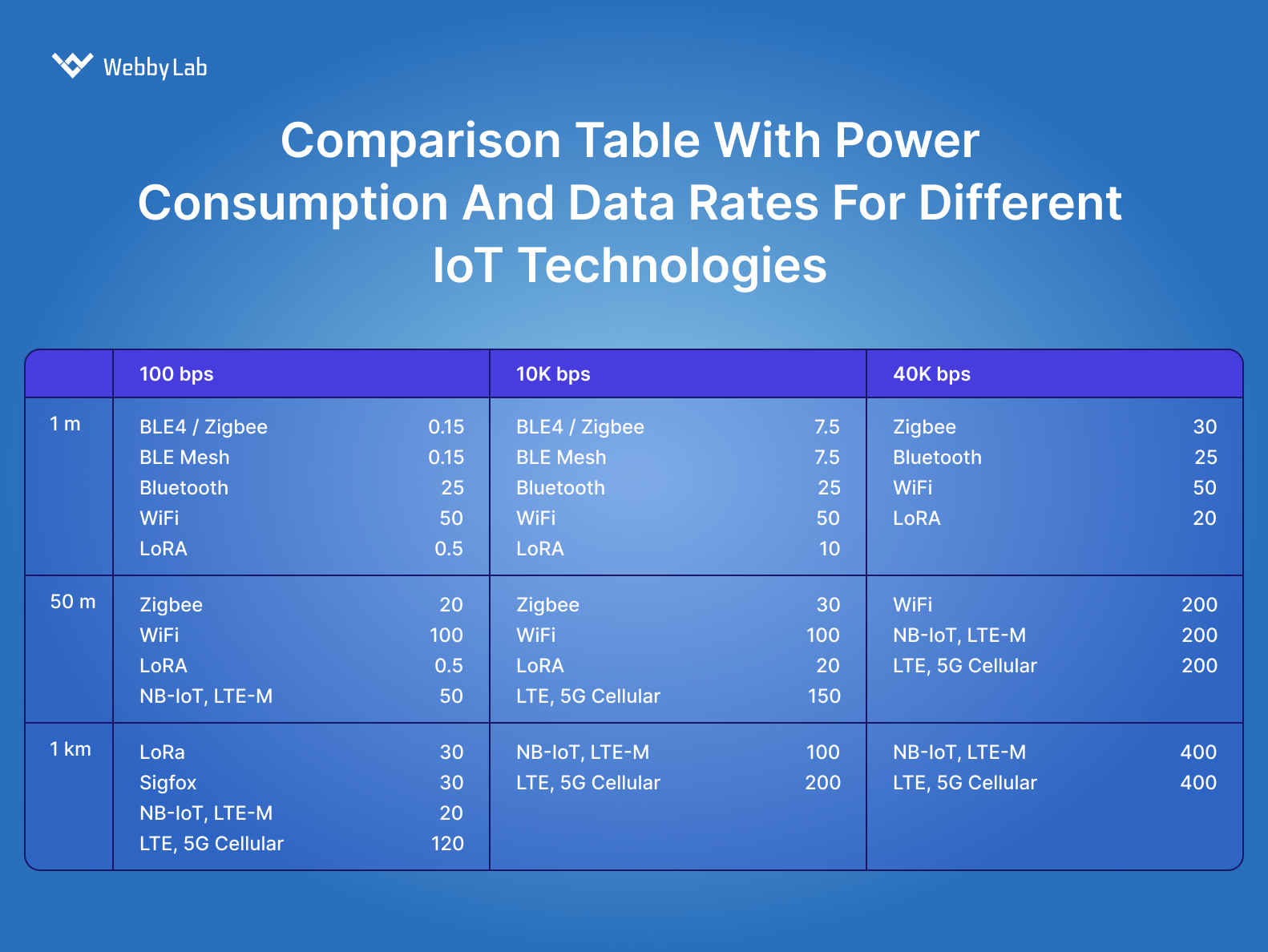
Power consumption and data rates for wireless IoT connectivity technologies
Scalability and Cost
Connectivity costs can be largely divided into two categories:
- CAPEX: modules, gateways, system core, installation, bases
- OPEX: internet traffic/data transfer costs, licenses, maintenance and support
Here’s your brief IoT connectivity cost comparison:
| Costs | Technologies |
| Minimum | Wi-Fi, Ethernet, Bluetooth/BLE |
| Low | BLE Mesh, Zigbee, Z-Wave, Thread (Matter) |
| Medium | LoRaWAN (private), Wi-SUN FAN (private) |
| High CAPEX, low OPEX | Industrial TSCH networks, private LTE/5G |
| High CAPEX, mid-to-high OPEX | Cellular IoT, LoRaWAN |
| Medium CAPEX, highest OPEX | Satellite IoT |
As for scalability, Wi-SUN FAN and Industrial TSCH will be more suitable for networks consisting of hundreds or thousands of nodes.
Security and Reliability
Each technology comes with certain advantages when it comes to security. For example, cellular IoT and private LTE/5G enable SIM/eSIM authentication and carrier-level security.
As for building reliable IoT networks, if you need an uptime of over 99.9%, consider hybrid IoT connectivity. For example, you can combine cellular IoT with Ethernet or Wi-Fi.
Other Considerations
On top of these factors, give some thought to the environment, IoT device density and mobility, and applicable regulatory requirements.
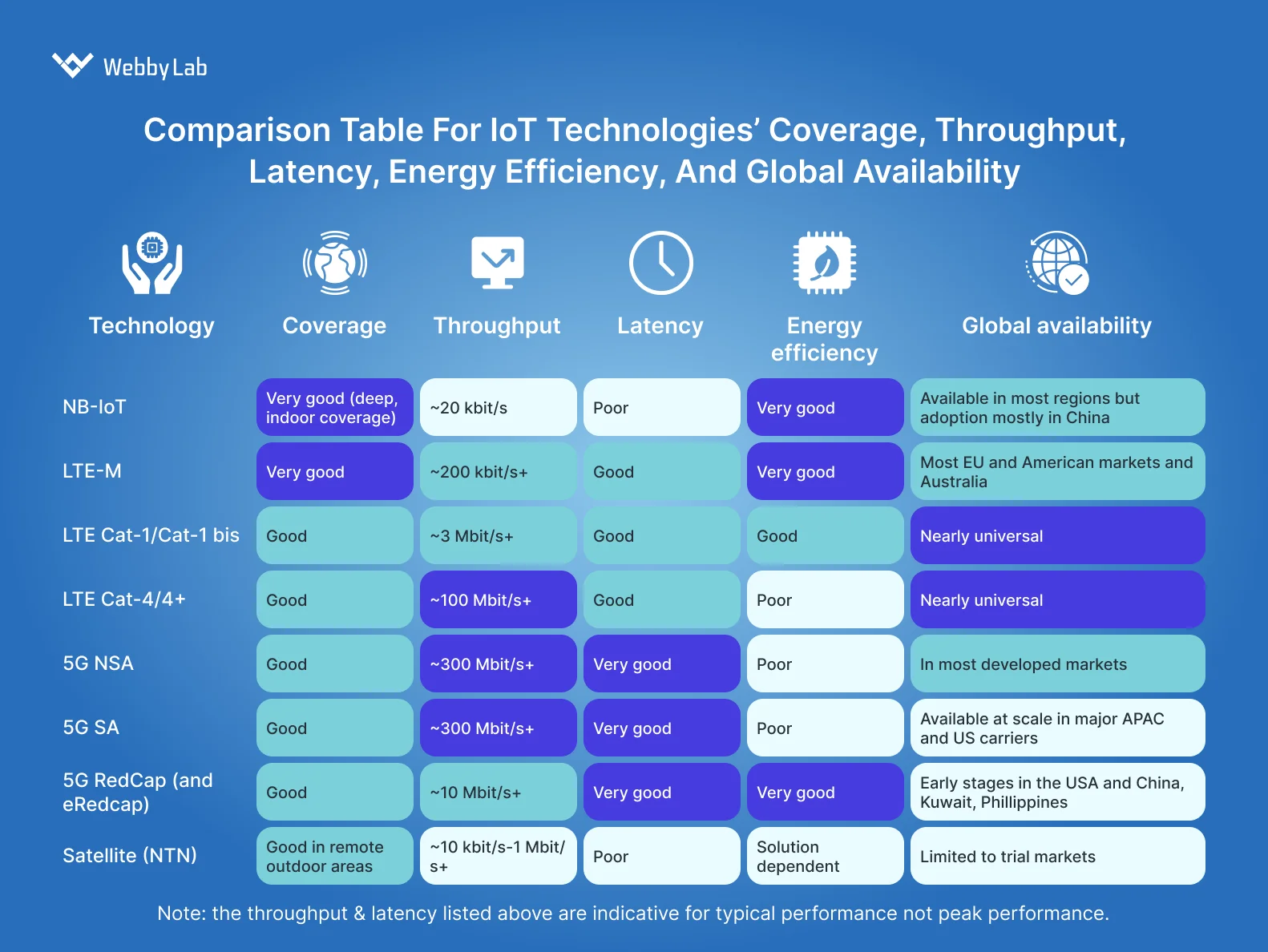
IoT connectivity technologies comparison
Consider how IoT connectivity impacts device performance, too. For example, older devices may require developing new firmware.
Not sure which technologies are the best IoT connectivity options in your specific case? Discuss it with WebbyLab — our experts will help you pick the right ones.
Contact us5 IoT Deployment Challenges to Prepare For
When we provide custom IoT development services, we help businesses navigate multiple real-world implementation challenges to set up reliable IoT networks. The most common among them are:
- Hardware compatibility (read our ZigBee Gateway case study to learn more)
- IoT device management in large-scale implementations
- Throughput vs battery life tradeoff
- Multi-region coverage with varying spectrum regulations and de facto standards
Vendor dependency and integration issues caused by fragmentation (case in point: IoT building automation systems)
What Is the Future of IoT Connectivity?
Moving forward, AI and 5G are poised to shape the future of IoT connectivity. In IoT connectivity for industrial applications, for example, AI models can analyze real-time IoT sensor data to detect early signs of future failures and recommend further actions (predictive maintenance).
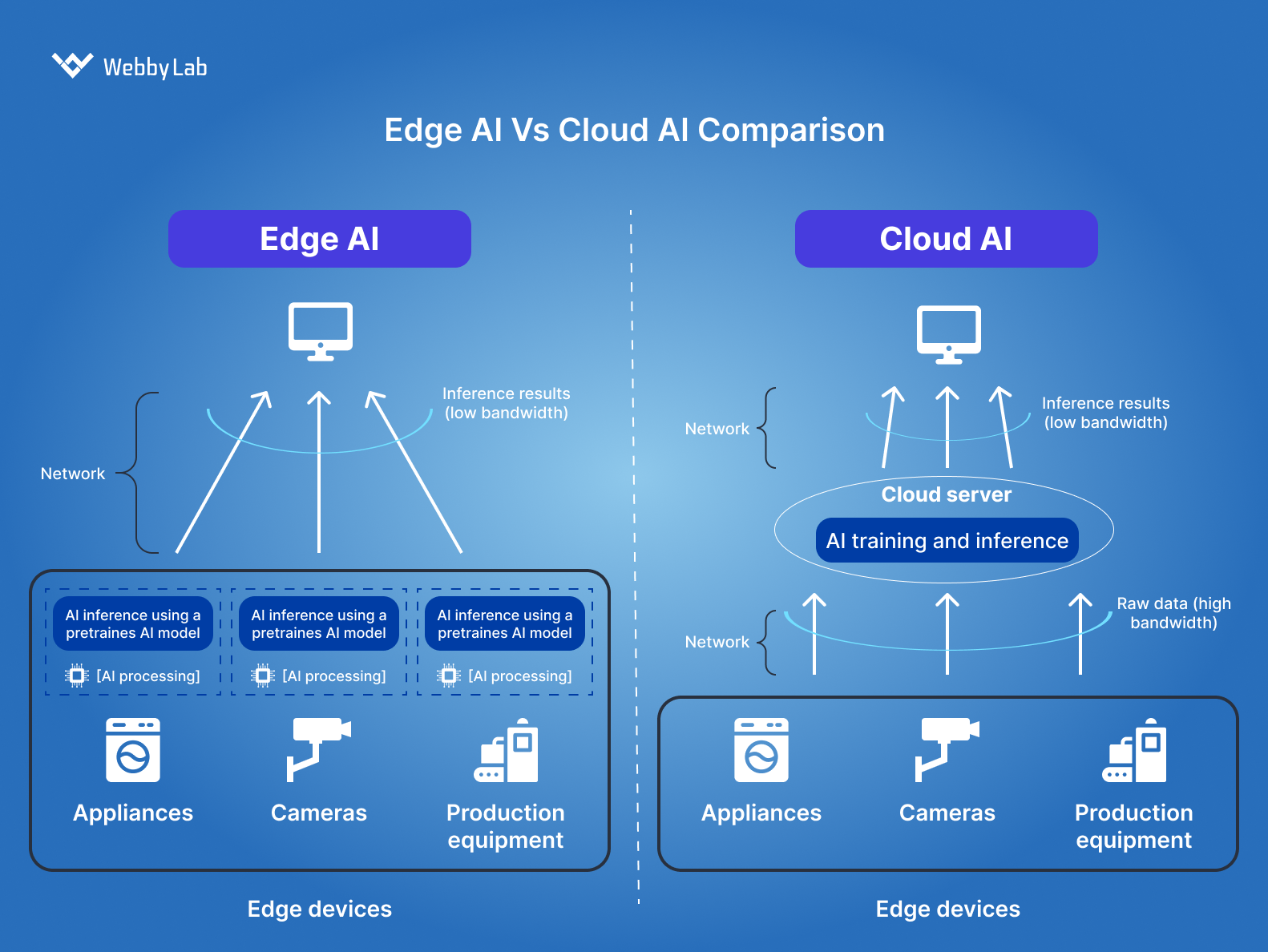
Edge AI vs cloud AI
Other trends in IoT connectivity for smart devices include:
- Private 5G networks. Enterprises can use 3GPP 5G technology and a licensed radio spectrum to carry data.
- Edge computing. Processing and analyzing data in edge devices isn’t new, but edge AI is emerging as its new application.
- AI-powered bandwidth optimization. An AI-driven resource allocation system can predict traffic patterns and automatically optimize bandwidth.
Want to future-proof your IoT setup? Learn how WebbyLab can help you do it with AI-driven connectivity solutions.
Get in touchFinal Thoughts
So, what is the best connectivity option for IoT devices? Well, it depends. Coverage and range, latency and data transfer, energy efficiency, and other requirements are just some of the factors you’ll have to consider.


Written by:

Kostiantyn Oliynyk
Head of IoT at Webbylab
With a robust academic background in Telecommunication Systems Engineering, I apply my knowledge to lead innovations in the IoT domain. Starting as the first team member in the newly formed IoT department at WebbyLab, I've spearheaded its growth, fostering the expansion into embedded and hardware development alongside our core software projects. My dedication lies in pushing the boundaries of IoT technology, fostering a culture of innovation and excellence that profoundly impacts our clients' operational success.


FAQ
How can I reduce IoT connectivity costs without losing reliability?
Edge processing and data compression can help reduce costs. Consider automating device management and reducing roaming exposure, too.
Can I switch IoT connectivity providers after deployment?
Yes, but depending on the setup, switching providers can be costly and create disruptions. To avoid vendor lock-in, plan your connectivity to be vendor-agnostic (e.g., opt for eSIMs instead of physical SIM cards).
What happens if my IoT devices lose connectivity temporarily?
Connectivity disruptions cause data blockages and service interruptions. Those can, in turn, frustrate customers and create operational risks.
Is hybrid IoT connectivity a good idea?
Combining several connectivity technologies is a good idea if you need high uptime or your network comprises diverse devices or locations.