
IoT Energy Management for HVAC Manufacturers: What a Connected Platform Actually Delivers
What you’ll take away from this article:
- Why fewer than 10% of EU HVAC brands have a connected platform and why that gap is closing fast
- What market leaders like Viessmann, Daikin, and NIBE actually built and the business outcomes they’re now generating
- What EU Cyber Resilience Act compliance means for your product roadmap before December 2027
- The six business outcomes a connected platform delivers beyond “your boiler on an app”
- What a manufacturer-grade IoT platform looks like in practice: architecture, timeline, and where to start
Most HVAC manufacturers know they need to move on connectivity. The harder question is where to start, what it actually costs, and whether the business case holds. This article works through each of those questions honestly, drawing on what market leaders have built, what independent data shows, and what a realistic platform build looks like for a mid-size manufacturer.
IoT energy management for HVAC manufacturers is no longer optional — it’s the line between category leader and follower.
There are over 250 HVAC equipment brands operating across the EU and UK today. Fewer than 10% have a branded, manufacturer-owned IoT platform. Meanwhile, the EU Cyber Resilience Act, which requires full compliance by December 2027, mandates that all manufacturers of connected products provide security update mechanisms for the product’s supported lifecycle. If your equipment has any network connectivity, OTA firmware update capability stops being a feature and becomes a legal requirement.
The competitive window is real. And it is narrowing.
The Connected HVAC Market in 2026: Leaders, Laggards, and the Closing Window
The manufacturers who moved first on connectivity have been compounding their advantage for years. Understanding what they built and what it delivers is the starting point for any honest evaluation.
| Brand | Platform | What it delivers |
|---|---|---|
| Viessmann | ViCare / ViGuide | Remote monitoring and control for homeowners; energy savings assistant; commissioning and remote service tools for installer network via ViGuide |
| NIBE | NIBE Uplink | Full heat pump ecosystem with remote monitoring; smart grid and energy tariff integration; dealer diagnostics |
| ÖkoFEN | Pelletronic / MyPelletronic | Predictive maintenance for biomass boilers; strong dealer and end-user lock-in across Central European markets |
| Daikin | Daikin Onecta / Daikin Cloud | Consumer app for heat pumps and air conditioning; Daikin Cloud Residential enables remote monitoring by installers for faster diagnostics and lower service costs |
These are not technology companies that happen to make heating equipment. They are hardware manufacturers who made a deliberate decision to own the software layer above their product. That decision is now paying off in lower service costs, stronger customer retention, and a competitive position that a price reduction or spec sheet cannot replicate.
The 200+ brands still competing primarily on price, warranty terms, and installer relationships are not in a stable position. Those are eroding advantages in a market where connected platforms create stickiness that hardware alone cannot.
The competitive logic is straightforward: the first mid-size manufacturer in a product category to launch a connected platform gains a decisive edge. The second gets a commodity comparison.
Two Deadlines That Are Now Part of Every Product Roadmap
Before working through the business case, it is worth being direct about two external pressures that have moved from “future consideration” to “active planning requirement.”
The EU Cyber Resilience Act — full compliance required by December 11, 2027
The CRA entered into force in December 2024. Reporting obligations for vulnerabilities and incidents apply from September 2026. The full set of product requirements, including mandatory security update mechanisms for connected products, applies from December 11, 2027.
In practical terms: any heating equipment with network connectivity is a “product with digital elements” under the CRA. Manufacturers must be able to deploy security updates across their connected fleet throughout the product’s supported lifecycle. OTA (over-the-air) firmware update capability is the primary technical mechanism for meeting this requirement. Non-compliance carries fines of up to €15 million and market exclusion.
This is not a 2027 problem. Hardware product development and testing cycles for HVAC manufacturers typically span 18–36 months. If OTA architecture is not already included in your next connected product generation’s design, the timeline is tight.
The competitive compounding effect
Every year a connected platform is live, its value increases: more device data, better failure pattern analysis, stronger customer retention, more OTA iterations. A manufacturer that launches in 2025 does not just have a two-year head start on one that launches in 2027; it has a materially more mature platform, richer dataset, and deeper service team capability.
Both deadlines point to the same conclusion: the question is no longer whether to build, but how to do it well.
What IoT Energy Management Actually Delivers for a Heating Equipment Manufacturer
The business case for a connected heating equipment platform is not a technology story. It is an operational and commercial story. Here is what changes across your P&L and your product when your equipment is generating live data.
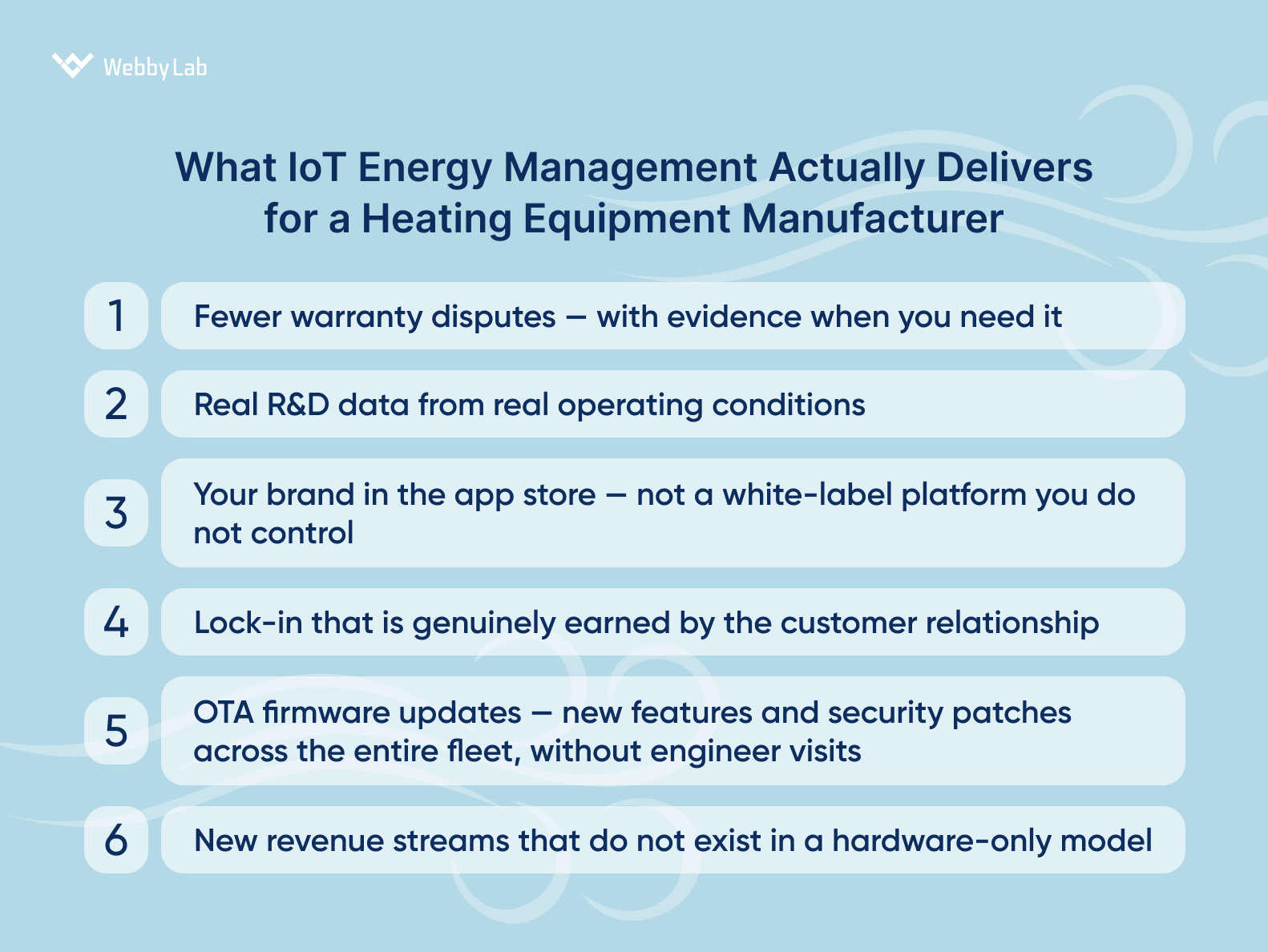
Business outcomes of IoT energy management for HVAC manufacturers, from warranty cost reduction to recurring revenue
1. Fewer warranty disputes with evidence when you need it
Without connectivity, a warranty claim is a negotiation. The engineer visits, the customer reports a failure, and the manufacturer pays. The operational history of the unit does not exist, or exists only in a local controller log that is impossible to audit remotely.
With a cloud-connected platform, every operational event: every temperature reading, error code, usage pattern, and shutdown sequence, is logged and timestamped in your backend. When a warranty claim arrives, you have a complete and verifiable record.
Industry analysis consistently shows 20–35% reduction in warranty costs for manufacturers who implement IoT telemetry logging, not by disputing legitimate claims, but because the data clearly distinguishes equipment failure from user error, incorrect installation, or out-of-specification operation.
2. Real R&D data from real operating conditions
Lab testing is controlled, expensive, and inherently limited to the conditions you can simulate. A connected fleet of even 500 units running through a heating season across Germany, the Netherlands, and Austria generates data that no lab programme can replicate: real failure rates, regional usage behaviours, COP degradation curves across different installation types, and long-tail failure modes that only appear at scale.
That telemetry feeds directly into your next product generation. Faster iteration cycles. Lower testing costs. Better design decisions grounded in evidence from thousands of real installations, not assumptions from controlled trials.
3. Your brand in the app store, not a white-label platform you do not control
Off-the-shelf IoT platforms exist. Some are technically capable. None of them put your logo in the App Store under your company name.
When a homeowner downloads an app to control their heat pump, the brand they interact with daily is the one they remember when the system needs replacing in 12 years. A manufacturer-owned, branded mobile app creates a direct brand relationship and daily touch points across the entire product lifetime, not just at the point of sale.
This is not a cosmetic difference. It is a structural advantage in how customers relate to your product, and how your brand compounds over time.
4. Lock-in that is genuinely earned by the customer relationship
A connected customer has accumulated real value inside your platform: their heating schedule, energy reports, service history, and alert preferences. Switching to a competitor means losing all of it. This is not manipulative retention; it is genuine value creation. The customer benefits from the continuity of their own data.
The commercial side effect is significant: repeat purchase rates increase when customers are invested in an ecosystem. And because all data sits on your private cloud infrastructure, not a shared SaaS vendor’s, that customer relationship is an asset you own outright, not one tied to a vendor contract.
5. OTA firmware updates — new features and security patches across the entire fleet, without engineer visits
New features, bug fixes, performance improvements, and CRA compliance updates are deployed to every unit in your connected fleet from a single admin dashboard. Staged rollout capability means you push to a subset of devices first, monitor behaviour and error rates, then deploy to the full fleet.
This is how market leaders respond to a discovered vulnerability in hours rather than quarters. And under the EU CRA, OTA firmware update capability is exactly how manufacturers will demonstrate ongoing lifecycle security compliance.
6. New revenue streams that do not exist in a hardware-only model
Hardware margins in HVAC are under pressure across segments. A connected platform opens a new P&L column that simply did not exist before: recurring software and service revenue.
Subscription tiers for premium monitoring features. Demand response partnerships with energy grid operators. Affiliate integrations with energy suppliers or installers. Premium service contracts backed by real-time diagnostics. For a manufacturer with 10,000 connected units, even a conservative subscription model generates meaningful recurring revenue IoT streams, a number that scales with fleet size and does not require additional unit sales to grow.
What this means for your service and dealer network
The business case extends beyond the product. For the engineers and dealers who install and support your equipment, a connected platform changes the economics of every service interaction:
- Remote diagnostics HVAC capability allows technicians to identify the fault and likely cause before leaving the depot, resolving a meaningful share of issues without a site visit at all
- Pre-arrival diagnosis means the correct part is in the van before the engineer arrives, directly improving first-visit fix rates and reducing repeat call-outs
- End users benefit from weather compensation algorithms that reduce energy consumption per heating season, and proactive alerts, such as freeze protection triggered below +5°C, that prevent costly damage before it occurs
See how we built a fleet IoT management platform with MQTT telemetry, OTA updates, Grafana monitoring, and a full admin panel: MyBox fleet IoT management case study →
What a Manufacturer-Grade HVAC IoT Platform Looks Like Under the Hood
A production-ready connected heating equipment platform for a mid-size manufacturer has four distinct layers. The critical distinction from an off-the-shelf solution: each layer is owned and operated by the manufacturer, not leased from a platform vendor.
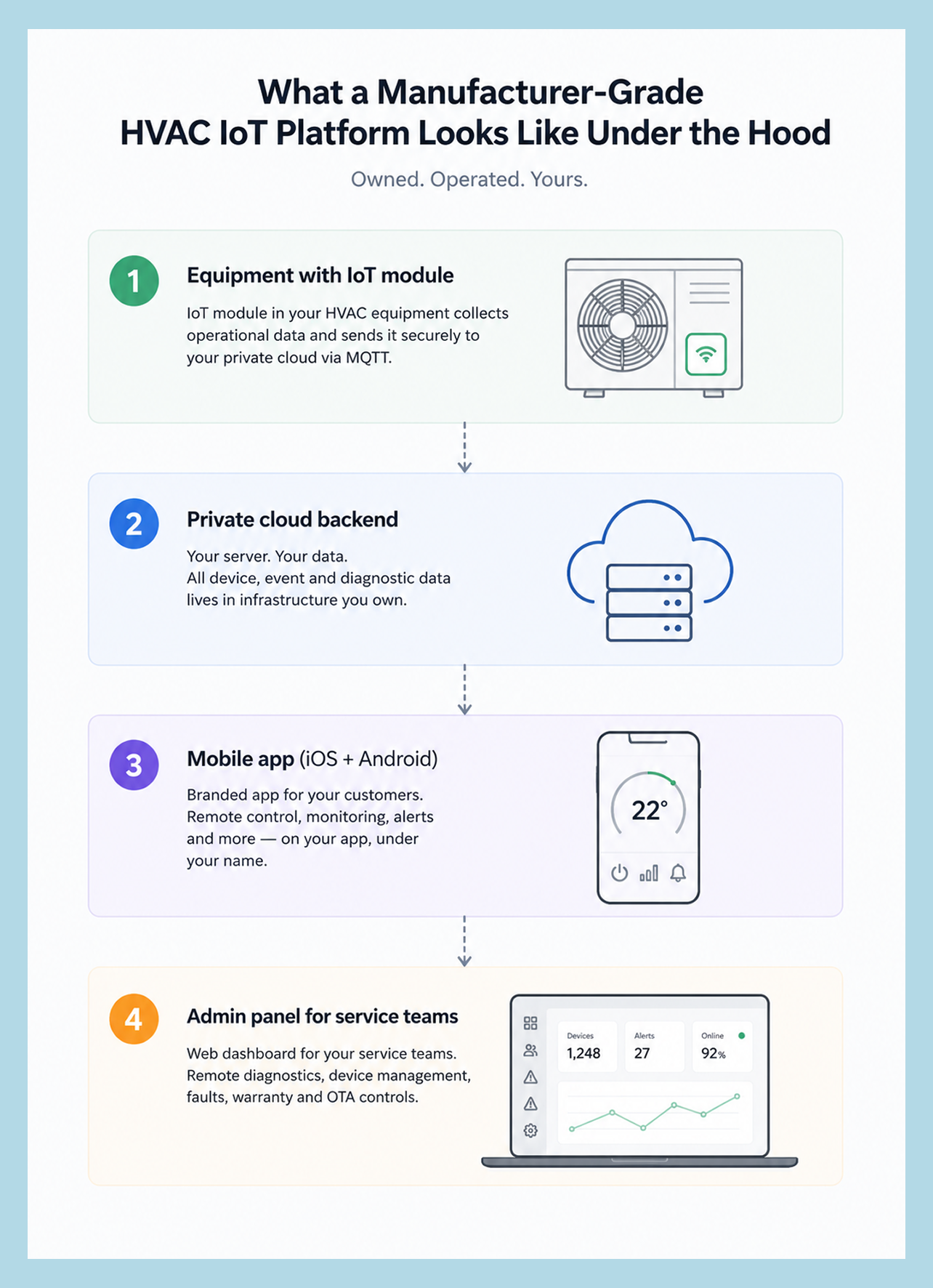
A manufacturer-owned HVAC IoT platform consists of four layers, all under your brand, on your infrastructure, with your data.
Layer 1. Equipment with IoT module Firmware embedded in your controller reads operational parameters: temperature, COP efficiency, fault codes, runtime cycles, and transmits them to your private cloud via MQTT telemetry. In most cases, this integrates with existing controller hardware. You do not need to redesign your product from the ground up to add connectivity.
Layer 2. Private cloud backend Your server, your data. All historical data, every device, every event, every diagnostic log, sits in infrastructure you own. When you end a vendor relationship or change development partners, you do not lose years of fleet data. The data stays, because it was always yours.
Layer 3. Mobile app (iOS + Android) Branded with your name, your logo, your product identity. Remote control, scheduling, energy monitoring, push alerts, and service notifications, all inside a smart HVAC platform app that appears in the App Store under your company name. Not a white-label. Not a platform you share with competitors. Your product.
Layer 4. Admin panel for service teams A web-based dashboard for your service centres and dealer network. Remote diagnostics, device registry, warranty history, fault tracking, fleet device management, and OTA deployment controls. Closes the information gap between your service organisation and the installed base permanently.
For a technical look at what rigorous IoT testing looks like inside a manufacturer-grade build: IoT testing best practices →
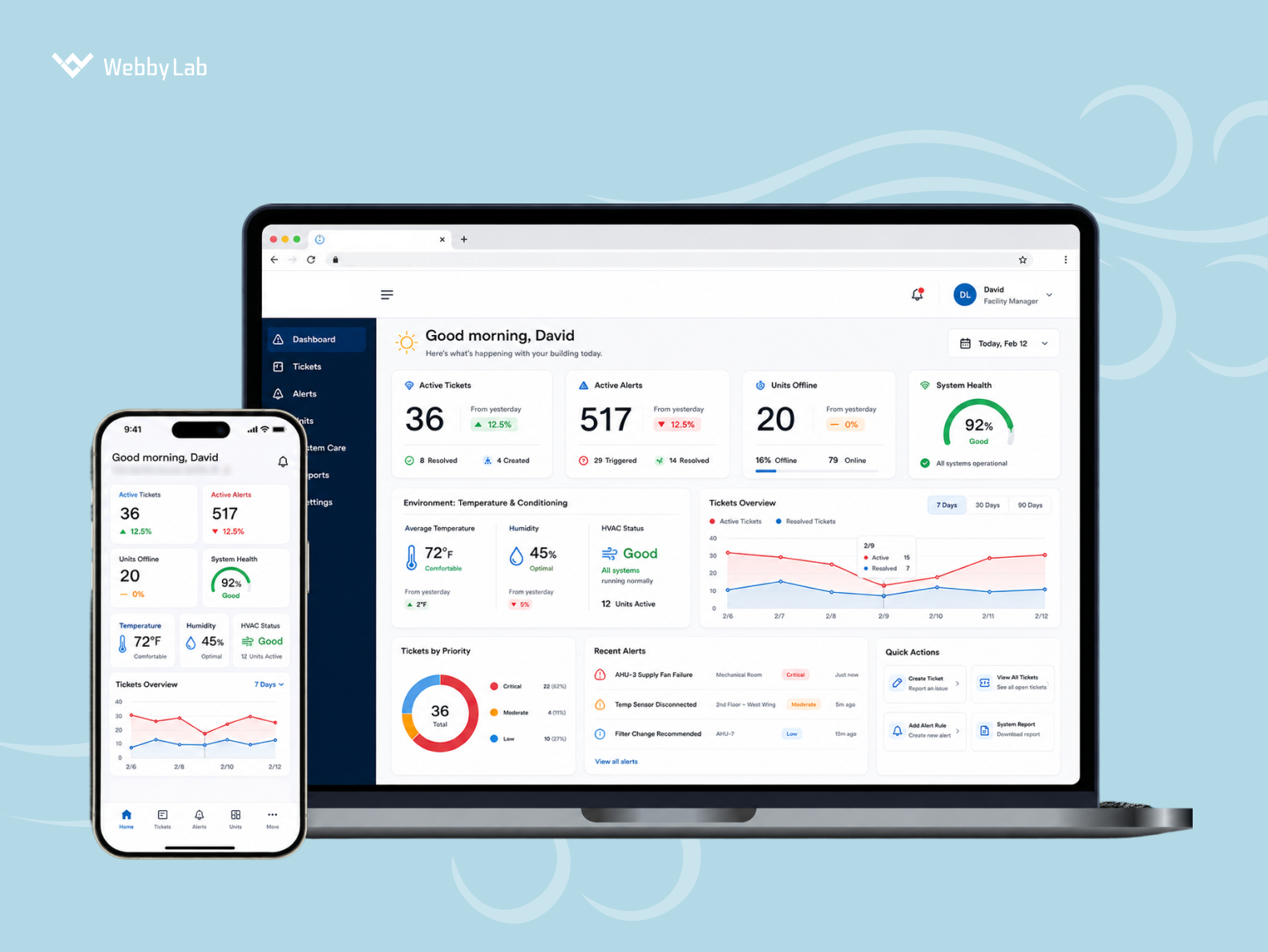
A manufacturer-grade IoT platform gives facility and service teams full visibility into connected equipment — from any device.
A realistic implementation timeline
| Phase | Duration | What gets delivered |
|---|---|---|
| Proof of Concept | 1–2 weeks | IoT module integration with your existing controller, basic telemetry stream to a test server, confirms hardware and architecture compatibility before any budget commitment |
| Full platform build | 6–10 weeks | Firmware, private cloud backend, iOS + Android apps, admin panel — all components integrated and live |
| Launch and ongoing | Continuous | App Store / Google Play publication, service team training, feature roadmap: weather compensation, COP optimisation, smart home integration |
The PoC phase is the most important step for a CEO making a first platform decision. Before committing full build budget, you validate that your controller hardware integrates cleanly and that the architecture works with your specific product. Most compatibility questions resolve within the first week.
Related: IoT product development guide → · OTA firmware updates in practice →
The Business Case: What the Numbers Actually Show
The financial logic here is worth working through concretely, using independently sourced figures rather than vendor marketing claims.
Service efficiency IoT Analytics’ 2024 Use Case Adoption Report found that a majority of IoT implementations now report positive ROI, a 13 percentage point increase compared to 2021. For field service specifically, remote diagnostic capability consistently reduces unnecessary site visits. At typical EU service costs of €30–60 per call-out, a meaningful reduction in on-site visits compounds quickly across any dealer network at scale.
Maintenance and warranty cost reduction Manufacturers adopting IoT-based remote diagnostics and predictive monitoring report 25–30% reductions in maintenance costs, according to Deloitte’s 2025 Smart Manufacturing Survey. The mechanism is direct: knowing the fault before the visit, carrying the right part, and resolving issues remotely when possible. On warranty costs specifically, IoT telemetry logging has been shown to reduce warranty payouts 20–35% through evidence-based claim resolution.
R&D cost reduction Real-world telemetry from hundreds of units in varied operating conditions replaces months of controlled lab testing. Heat pump data analytics and failure pattern analysis at fleet scale drive better product decisions earlier and at lower cost than any lab programme.
New recurring revenue Connected fleet monetisation, even at conservative rates, creates recurring revenue IoT streams that do not exist in a hardware-only model and do not require incremental unit sales to grow.
Payback timeline For a connected fleet of 1,000+ units, payback typically falls within 12–24 months. Service efficiency gains and warranty cost reductions drive Year 1 returns. Customer lock-in, retention, and recurring revenue compound over subsequent years.
Want to work through the numbers for your specific product line and fleet size?
Book a free scopingReady to See What Your Equipment Looks Like Connected?
The EU CRA compliance deadline is fixed. The competitive gap between manufacturers with connected platforms and those without is widening every year. The manufacturers who act in the next 12–18 months will have a meaningful head start in regulatory readiness and in the compounding commercial value of an established, data-rich connected fleet.
The lowest-risk way to evaluate this for your product is a Proof of Concept: your existing controller, our firmware, connected to a test cloud environment in 1–2 weeks. No commitment to a full build. You see exactly what a connected heating equipment platform delivers for your specific hardware before making any further decision.
Ready to see what your equipment looks like connected? Free Proof of Concept: your controller connected in 1–2 weeks. No commitment.
Book a Free PoC Scoping CallRelated WebbyLab services: IoT consulting services · IoT app development services · IoT solutions for enterprise
Related reading: Smart HVAC monitoring with AI-powered label detection → · Fleet IoT management: MyBox case study →


Written by:

Kostiantyn Oliynyk
Head of IoT at Webbylab
With a robust academic background in Telecommunication Systems Engineering, I apply my knowledge to lead innovations in the IoT domain. Starting as the first team member in the newly formed IoT department at WebbyLab, I've spearheaded its growth, fostering the expansion into embedded and hardware development alongside our core software projects. My dedication lies in pushing the boundaries of IoT technology, fostering a culture of innovation and excellence that profoundly impacts our clients' operational success.


FAQ
What does an IoT energy management platform include for an HVAC manufacturer?
A manufacturer-grade platform has four components: IoT firmware in the equipment (telemetry and control layer), a private cloud backend for data storage and processing, a branded mobile app for end users (iOS and Android), and an admin panel for service centres and dealers. All data remains the manufacturer’s property, stored on infrastructure they control, not on a shared SaaS vendor’s servers.
Does EU Cyber Resilience Act compliance require OTA updates for HVAC equipment?
Yes. The EU CRA entered into force in December 2024, with full product requirements applying from December 11, 2027. It requires manufacturers of connected products to provide security update mechanisms throughout the product’s supported lifecycle. OTA firmware update capability is the primary technical mechanism for meeting this requirement. Any heating equipment with network connectivity falls within the CRA’s scope as a “product with digital elements.”
How long does it take to build an IoT platform for heating equipment?
A full smart HVAC platform — firmware, cloud backend, iOS/Android apps, and admin panel — typically takes 6–10 weeks to build. A Proof of Concept (controller integration and basic telemetry stream) can be delivered in 1–2 weeks, confirming technical feasibility before any full-build commitment.
What is the ROI of adding IoT to a heating equipment product line?
For fleets of 1,000+ units, payback typically occurs within 12–24 months. Primary drivers are reduced service call-outs, lower warranty costs through IoT-evidenced claims, and new recurring subscription revenue. IoT Analytics’ 2024 Use Case Adoption Report found that a majority of IoT projects now deliver positive ROI, a significant increase from 2021 findings.
Should we build our own IoT platform or use a third-party solution?
Off-the-shelf platforms offer faster initial setup but sacrifice brand ownership, data control, and competitive differentiation. Every market-leading HVAC manufacturer (Viessmann, Daikin, NIBE) built proprietary platforms. A manufacturer-owned connected product platform means your brand in the App Store, your data on your servers, and a product layer that competitors cannot replicate by changing a hardware component supplier.