
Using LoRa Devices and Gateways in Scalable IoT Solutions
Discover how LoRaWAN is perfect for IoT with its low energy usage, long-range connectivity, and cost-effectiveness. Explore use cases and architecture.
You might be monitoring crops in the middle of nowhere, tracking assets across cities, or managing equipment in tough-to-reach areas… But how do you keep thousands of devices connected without draining batteries or blowing your budget? Consider “long range” – LoRa in IoT solutions.
LoRaWAN technology works exactly for this. It’s low-power and cost-effective. In other words, it’s perfect for building scalable, low-maintenance networks — even in the most remote corners of the map.
In this post, WebbyLab will tell you how to reach this energy-efficient IoT connectivity with LoRa devices and gateways. We’ll discuss real-world use cases, technical aspects, and the business value behind it all.
Highlights:
- Smarter infrastructure with LoRa gateways reduces hardware needs — fewer towers, more coverage, less maintenance costs.
- Need reliable long-range monitoring? Use the LoRaWAN protocol and easily track and control devices across wide or remote areas.
- Benefit from LoRaWAN’s ultra-low-power design to extend your devices’ battery life for up to 10 years.
Got a project in mind? Talk to our engineers about your IoT goals.
What Makes LoRaWAN Ideal for Modern IoT?
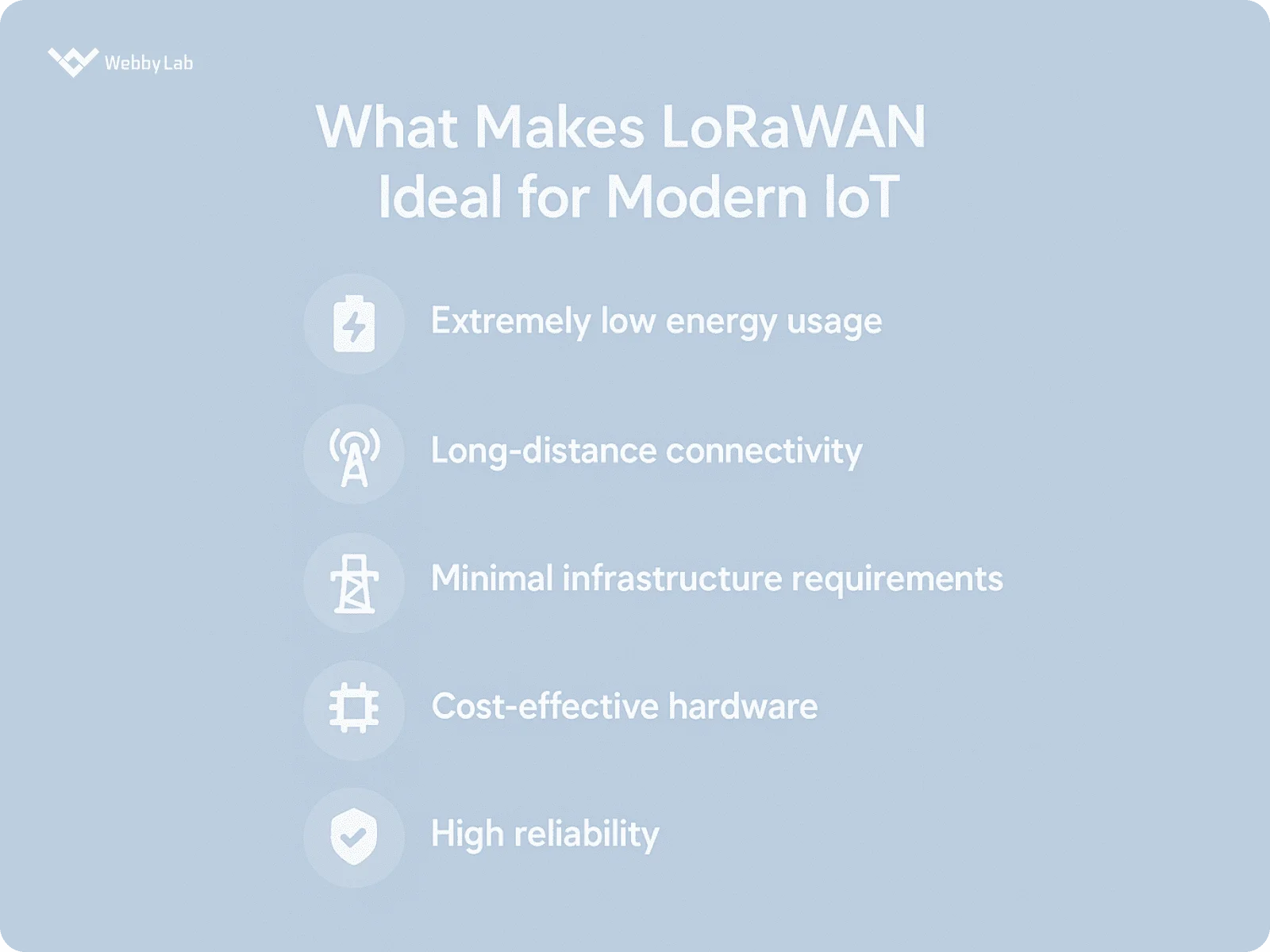
First things first: the benefits. Here’s what makes LoRaWAN devices the top choice for modern IoT applications:
- Extremely low energy usage. Under ideal conditions and proper configuration, devices can work for up to 10 years on a single battery — a game-changer for remote or hard-to-service locations.
- Long-distance connectivity. LoRaWAN ensures secure IoT data transmission over several kilometers — typically up to 5 km in dense urban zones and up to 15 km in ideal open conditions.
- Minimal infrastructure requirements. Given the wide range, you need significantly less infrastructure. Just a few LoRaWAN gateways can handle massive deployments.
- Cost-effective hardware. LoRaWAN sensors and devices are surprisingly affordable, which makes large-scale rollouts much more feasible.
- High reliability. With resistance to RF interference and CSS modulation, LoRaWAN is dependable even in noisy environments.

The reason LoRaWAN keeps getting more widespread is the work of the LoRa Alliance ecosystem. This global non-profit brings together nearly 500 member organizations — Amazon, Cisco, Semtech, and so on — to standardize and promote LoRaWAN technology for a low-power wide-area network (LPWAN). The Alliance also certifies devices and infrastructure to make sure they stay compatible and reliable in the long run.
Speaking of long-term reliability and future-ready solutions, WebbyLab experts know their way around. We can advise on the right LoRaWAN devices and ensure they connect smoothly. Want to learn how we do that? Check out our detailed guide to IoT gateways.
Let`s discuss how LoRaWAN can scale your IoT ecosystem.
Get a consultationReal-World Use Cases Across Industries
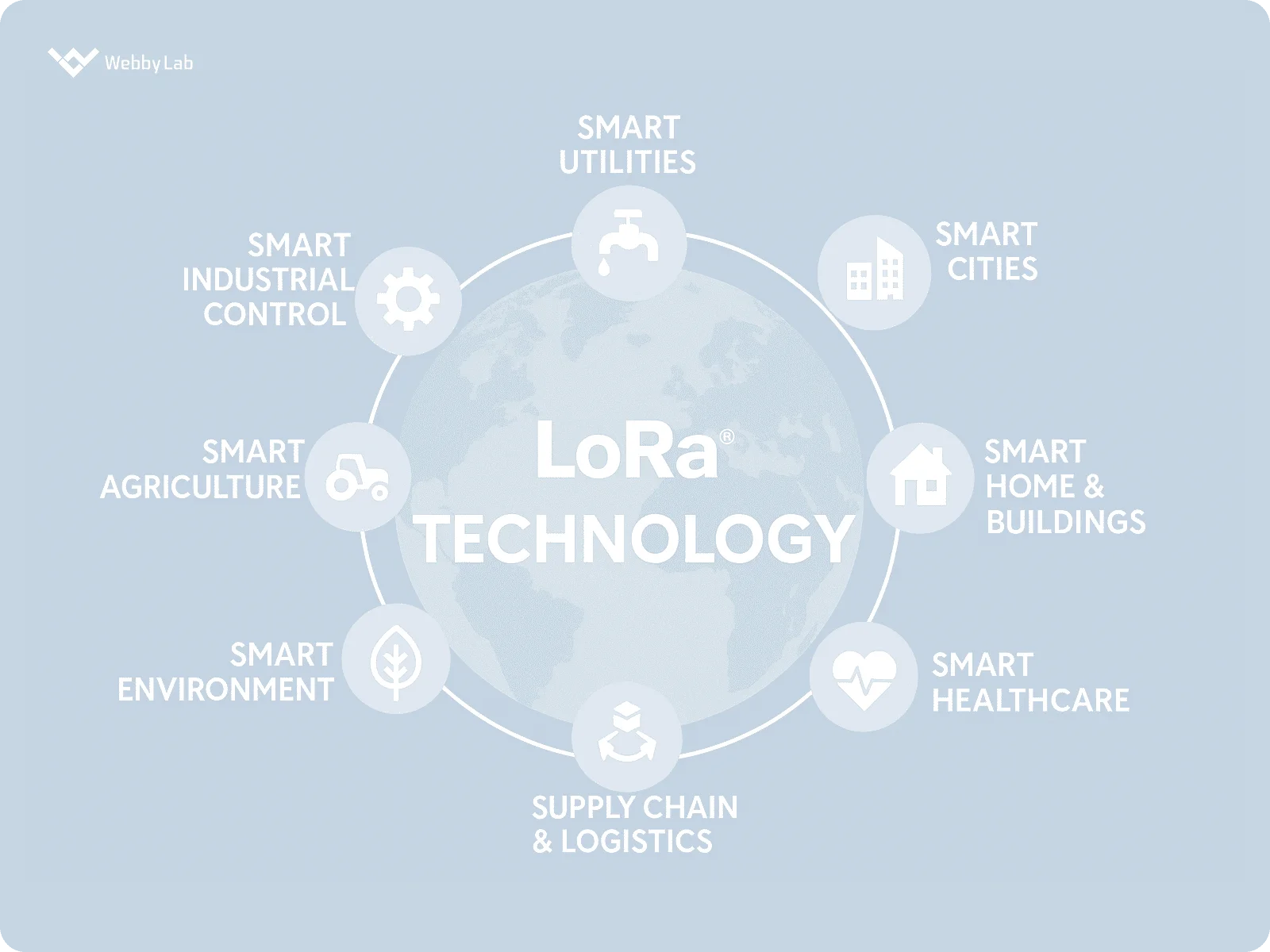
Real-world LoRaWAN use cases.
From busy cities to remote farms, LoRaWAN makes everyday operations smarter, faster, and more efficient. Here’s how different industries are putting LoRa-based IoT monitoring to work:
- Smart cities. LoRaWAN for smart cities enables efficient urban infrastructure management — think streetlight automation, garbage level detection, air quality monitoring, and smart parking. Using real-time data from IoT sensors with LoRa, cities save energy, reduce emissions, and improve residents’ quality of life.
- Smart buildings. LoRaWAN makes buildings more intuitive. It monitors energy use, adjusts the heating, ventilation, and air conditioning to be just right, and provides security with access control systems and fire alarms.
- Agriculture. LoRaWAN helps monitor soil moisture, temperature, crop health, and livestock movement. It’s used in smart irrigation systems and other smart farming solutions — leading to better yields and less waste.
- Logistics. Using LoRa-based IoT in logistics and supply chain extends to tracking every process, from warehousing to delivery. And every asset, from vehicles to containers.
- Utilities. Utilities may use LoRaWAN-based smart metering technology to read water, gas, and electricity parameters remotely. They can also power their smart grids with this tech.
- Industry. Industrial IoT with LoRaWAN lets factories control temperature and humidity in warehouses and ensure safety in the workplace. Plus, predictive maintenance with LoRaWAN gets easier with real-time equipment health monitoring.
- Healthcare. Hospitals and clinics can use LoRaWAN for everything from tracking medical equipment to monitoring patient conditions and controlling drug storage conditions.
- Environmental monitoring. LoRaWAN helps keep a close eye on our planet — things like river water level tracking, air quality monitoring, and forest fire detection.
See how LoRa can transform your operations — talk to our IoT consultants.
Let`s talk?Should I Use LoRa or LoRaWAN?
When exploring IoT connectivity technologies, you may have thought LoRa and LoRaWAN were two names for the same thing. And while they’re related, they serve different purposes in your stack.
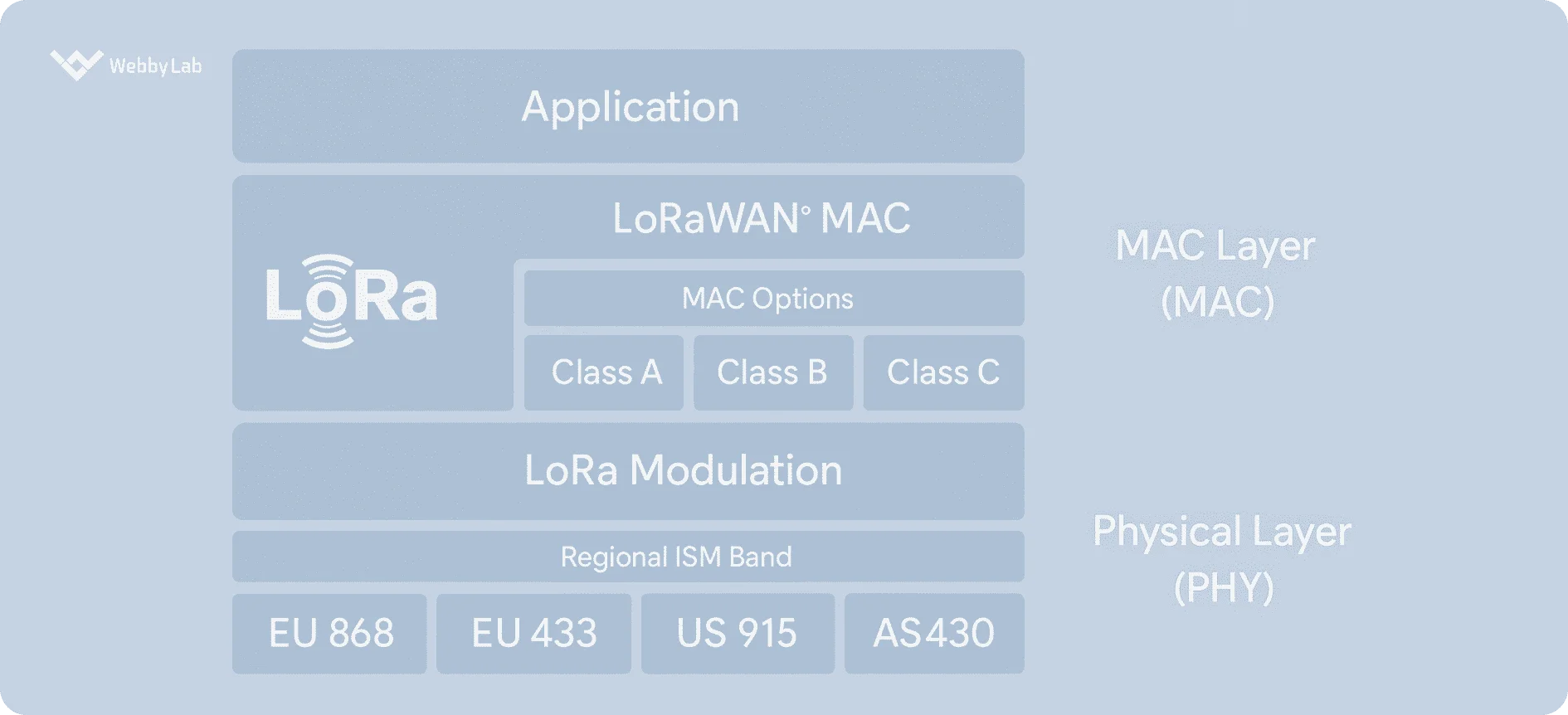
The difference between LoRa and LoRaWAN.
What Is LoRa?
LoRa, short for long range, is the radio frequency technology that powers the physical transmission of data. Thanks to chirp spread spectrum (CSS) modulation, it handles long-range communication and immunity to interference.
However, while LoRa covers the physical layer, it doesn’t manage how devices communicate with each other or the cloud — that’s LoRaWAN’s task.
What Is LoRaWAN?
LoRaWAN, short for long-range, wide-area network, is a protocol that defines how LoRa devices should communicate. It adds:
- Security with end-to-end encryption and authentication.
- Routing rules for sending data from devices to gateways and the cloud.
- Network management that includes device provisioning, updates, and message handling.
Simply put, LoRaWAN gives structure to the raw LoRa signals. It makes sure your data is delivered reliably, securely, and at the right time.
Why Are These Layers Important?
When planning your IoT infrastructure, keep the LoRa + LoRaWAN technology combo in mind. Here’s why:
- You’re not just choosing how far a sensor can transmit — you’re also deciding how that data is managed and integrated.
- It helps you decide between other tech stacks. For example, LoRaWAN vs Wi-Fi, where Wi-Fi can be simpler and more cost-effective for short-range use, but not suitable for long-range applications. Or in a LoRaWAN vs NB-IoT comparison, where LoRaWAN wins on simplicity and cost.
How We Build LoRa-Based IoT Architecture
The standard LoRaWAN architecture is built on a three-layer model: devices, gateways, and network servers. We use it to design scalable, secure, and energy-efficient IoT systems — without overengineering. Let’s see how it all works in combination:
The “Star-of-Stars” Topology
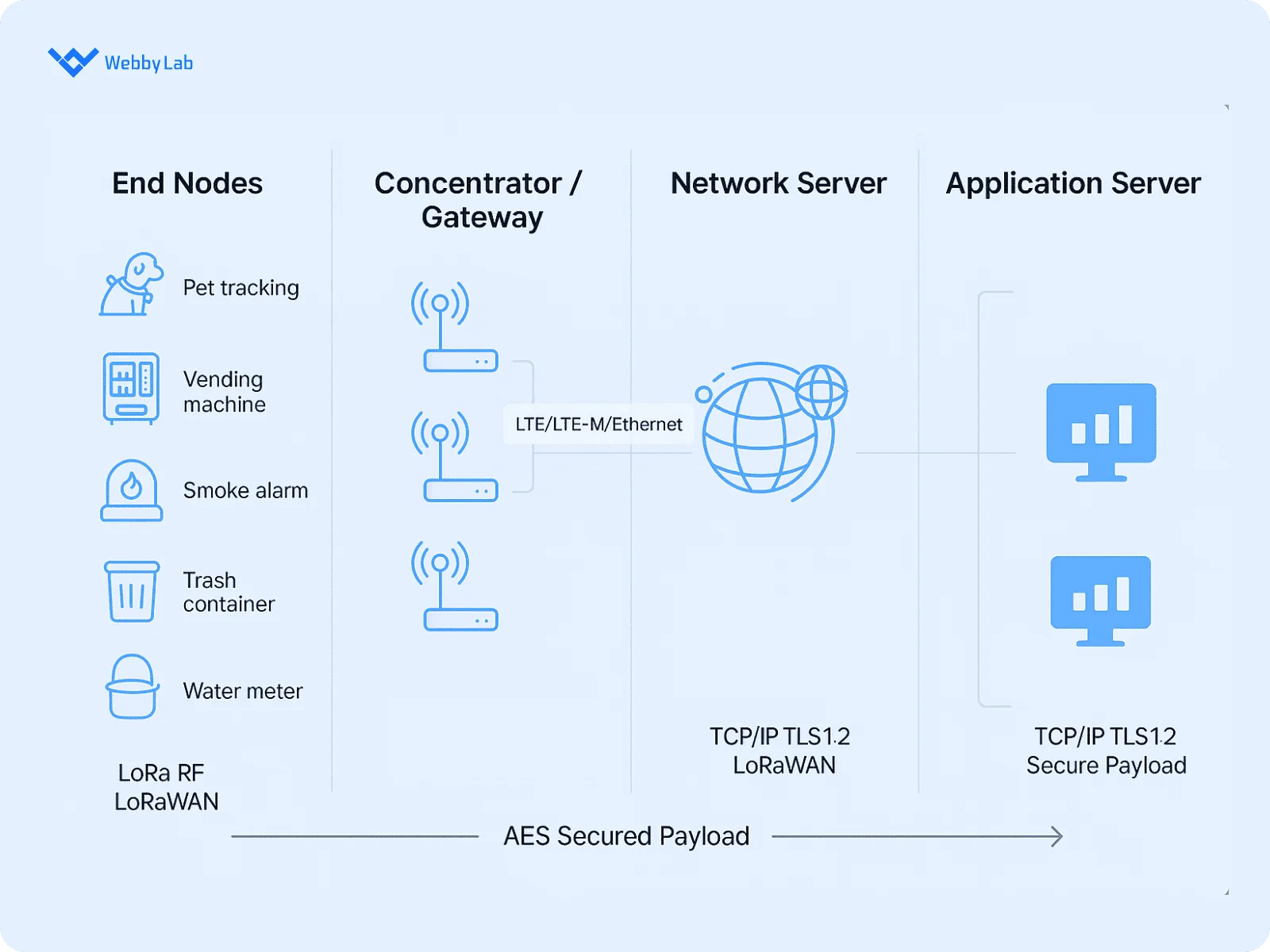
LoRaWAN network architecture.
Unlike mesh networks, where devices pass messages through each other, LoRaWAN uses a “star-of-stars” topology:
- End devices send data directly to one or more gateways.
- Gateways forward that data to a centralized network server.
- The network server processes, filters, and routes it to your apps.
This setup brings several big advantages:
- Scalability. Add more gateways, not more device configurations.
- Stability. Multiple gateways can receive signals from the same device, increasing stability and coverage.
- Simplicity. Devices stay lightweight and low-power, no mesh routing required.
In dense urban areas or large industrial zones, this hybrid “many-to-one” model gives LoRaWAN a serious edge in resiliency and reliability — especially where Wi-Fi or cellular IoT protocols aren’t viable.
1. End Devices/Nodes
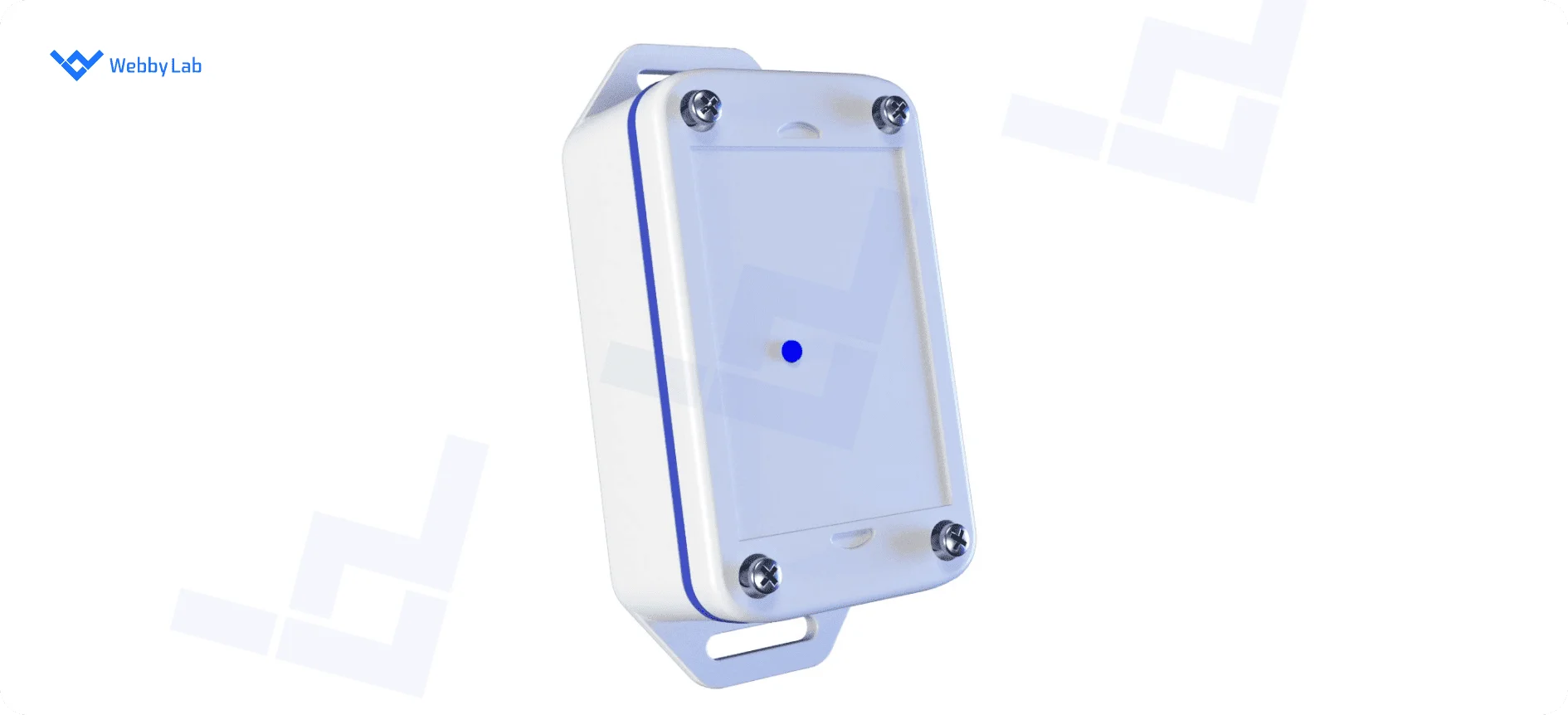
End device example.
These are the “things” in your IoT system — sensors, trackers, and smart meters that collect data from the real world. We select and configure them based on your use case. LoRaWAN devices:
- Track temperature, humidity, soil moisture, movement, or location.
- Send small data packets over LoRa radio waves to nearby gateways.
- Operate for years on a single battery, thanks to ultra-low power consumption.
- Integrate with sensors or other input/output devices easily.
- Demonstrate high immunity to RF interference.
Typical LoRaWAN devices include environmental sensors for air quality or water level monitoring, vehicle or asset trackers, agriculture tech for irrigation, and so on.
2. Gateways
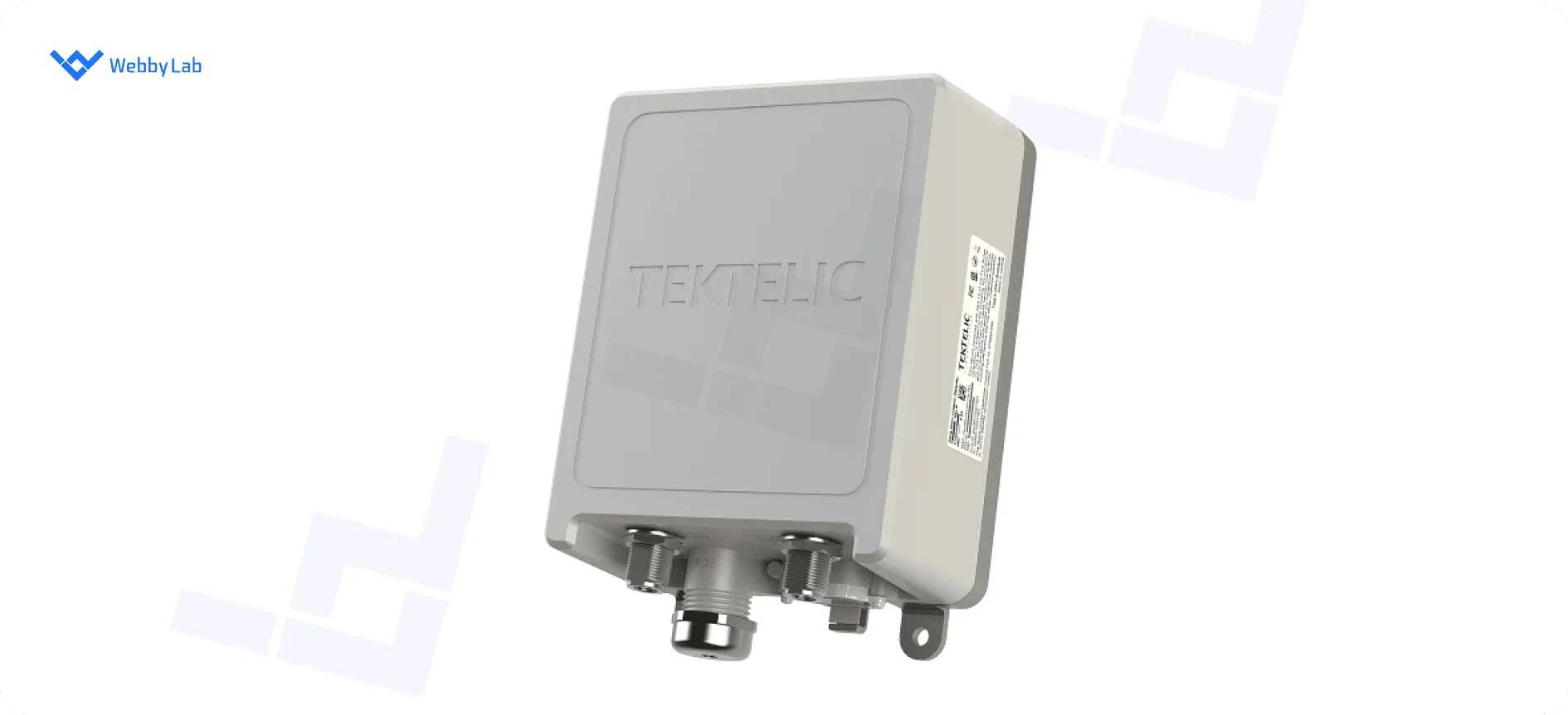
An outdoor LoRaWAN gateway by Tektelic.
LoRaWAN gateways work as transport bridges between LoRa devices and the network server. They receive messages from any nearby nodes and forward that data to the network server via an IP network — whether Wi-Fi, Ethernet, or LTE. Here’s what they bring to the table:
- Support for thousands of devices, ensuring network scalability.
- Easy installation and configuration, which reduces infrastructure costs.
- Support for a standard IP protocol for data transmission to the cloud.
On top of the above basic features, gateways offer intelligent functions. These include bi-directional communication in LoRaWAN — which supports uplink (device-to-cloud) and downlink (cloud-to-device) messages — and data filtering and verification.
3. Network Servers
The LoRaWAN network server receives all the data from gateways, filters and processes it, then routes it to your cloud platform or application. Its key functions are:
- Removing duplicate data packets from a single device through several different gateways.
- Managing encryption keys and device authentication.
- Handling adaptive data rate control (ADR) to optimize network traffic and battery use dynamically.
- Supporting remote IoT device management, including commands, firmware updates over-the-air (FUOTA), and LoRaWAN OTA updates.
All in all, a network server lets your system scale and stay secure.
Platforms We Use
We build LoRaWAN-based IoT systems using both open-source and commercial platforms, depending on your needs.
Open-source platforms:
- ChirpStack. The ChirpStack LoRaWAN server is a flexible solution that can be deployed both in the cloud and locally.
- The Things Stack. It’s great for both cloud and local deployments via The Things Network integration and The Things Stack Open Source, respectively.
Commercial platforms:
- LORIOT. It offers professional-grade cloud or on-prem LoRaWAN solutions.
- ResIOT. It’s a scalable platform built for smart cities and industrial IoT with LoRaWAN.
Discover how WebbyLab builds scalable IoT systems from scratch.
Browse moreSoftware Challenges and Best Practices in LoRaWAN Development
Software development for LoRa devices comes with several features that distinguish it from traditional IoT. In particular, LoRa technology introduces challenges around bandwidth, power usage, and a specific network topology.
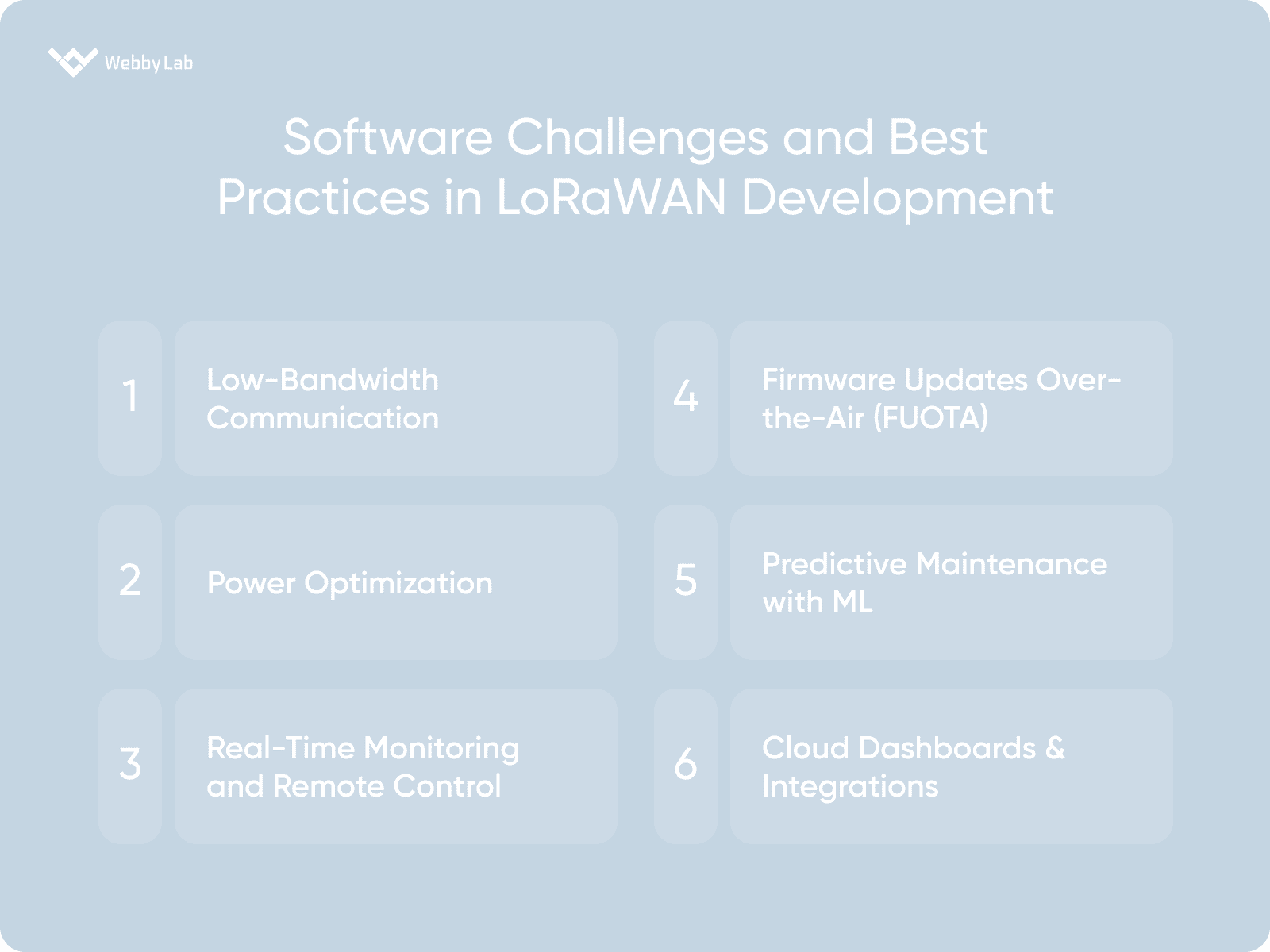
Yet, with the right practices, you can create scalable, energy-efficient IoT connectivity systems. Here’s what to pay attention to:
Low-Bandwidth Communication
LoRaWAN networks offer impressive range and low power usage, but they come with limited bandwidth, up to several hundred bytes per second. That means your software has to be lean and smart, namely:
- Use lightweight data formats.
- Pre-process and filter data at the device level.
- Aggregate sensor readings before transmission.
- Send data only when thresholds are crossed.
Power Optimization
Since LoRaWAN devices are often deployed in remote areas, battery life is everything. Use any of the following power-saving techniques:
- Put devices to sleep most of the time.
- Implement adaptive data transmission intervals based on device state or external conditions.
- Leverage the ADR feature to optimize battery use.
Real-Time Monitoring and Remote Control
Even with limited bandwidth, LoRaWAN supports bi-directional communication. This means devices can respond to commands or update settings remotely. Key features to implement:
- Remote device reboot or configuration changes.
- Real-time alerts for faults or threshold breaches.
- Scheduled tasks (for example, change the irrigation plan every Monday).
- Integration with dashboards for live system monitoring.
Firmware Updates Over-the-Air (FUOTA)
Once again, given the limited bandwidth and low power consumption, you need a unique way to update IoT devices powered by LoRaWAN. It’s called FUOTA. Here’s what this approach includes:
- Fragmented firmware transmission to handle low data rates.
- Secure update signing and validation.
- Fallback mechanisms in case of interrupted updates.
Predictive Maintenance with ML
If you want to fix your equipment long before it breaks, predictive maintenance is a must. And LoRaWAN devices provide the perfect data stream for it. Here’s how to implement predictive logic:
- Stream telemetry (vibrations, temperature, usage hours) from sensors.
- Use ML models to identify early signs of failure.
- Trigger alerts or work orders before problems become critical.
Cloud Dashboards & Integrations
Besides just collecting IoT data, you need to make sense of it. For this very purpose, you need cloud dashboards and handy third-party solutions.
- Integrate with platforms like AWS IoT, Azure IoT Hub, or custom servers.
- Use web and mobile dashboards for real-time data view and historical analysis.
- Implement role-based access, alert systems, and reporting tools.
- Handle API integrations with ERP, CRM, or other enterprise systems.
Conclusion: Putting It All Together
Building with LoRaWAN means more than just deploying sensors — it’s about designing a full-stack system that’s made to last. Remember the following components of IoT development with LoRa:
- Network server. Handles data collection, routing, device authentication, and security.
- Application server. Processes data, manages control logic, and handles system integrations.
- OTA updates manager. Coordinates secure remote firmware updates
- User interfaces. Web and mobile apps for user access, control, and monitoring.
- ML/analytics engine. Generates insights for predictive maintenance and performance tuning.
With a profound expertise in LoRa and LoRaWAN, WebbyLab knows how to deliver precisely the above components — and even more. So in case you need a reliable, scalable solution, safely count on our team.
Ready to build energy-efficient IoT software? Let’s chat about your LoRaWAN project!
Contact us


Written by:

Kostiantyn Oliynyk
Head of IoT at Webbylab
With a robust academic background in Telecommunication Systems Engineering, I apply my knowledge to lead innovations in the IoT domain. Starting as the first team member in the newly formed IoT department at WebbyLab, I've spearheaded its growth, fostering the expansion into embedded and hardware development alongside our core software projects. My dedication lies in pushing the boundaries of IoT technology, fostering a culture of innovation and excellence that profoundly impacts our clients' operational success.


FAQ
What kind of maintenance or operational costs are associated with LoRaWAN infrastructure?
The LoRaWAN infrastructure doesn’t incur a lot of maintenance expenses. Once installed, LoRa devices can run for several years on one battery, requiring little to no physical maintenance. Gateways also need minimal upkeep — especially with remote updates and cloud monitoring.
What are the alternatives to LoRaWAN technology?
There are several options depending on your needs:
- NB-IoT and LTE-M for cellular-based IoT with strong coverage but higher power use.
- Zigbee and Bluetooth Mesh for short-range, dense device networks.
- Wi-Fi HaLow for low-power, medium-range applications.
- Sigfox for ultra-low-data, low-power use, but with limited flexibility.
Each has trade-offs compared to LPWAN technology for IoT.
What equipment is needed to launch a LoRaWAN network?
To get started with LoRaWAN, you’ll require:
- LoRa devices like sensors, meters, or trackers.
- LoRaWAN gateways to receive and forward their signals.
- A network server to manage routing, security, and data handling.
Depending on your needs, the server can be cloud-based or local.
What is the working distance of LoRa?
LoRa is built for low-power, long-range IoT networks. In open areas with minimal interference, it can reach a maximum of 15 km in range. In urban environments, the range is typically around 2–5 km, depending on obstacles, building density, and network configuration.